9 Bedroom Ideas for Small Rooms Couples Need
Sharing a small bedroom is one of those relationship experiences that nobody adequately prepares you for. You’ve navigated the “whose furniture survives the merge” conversation, survived the great closet negotiation of move-in week, and somehow reached a détente on throw pillow quantity — and yet the room still feels like two people’s worth of life crammed into one person’s worth of space. Because that’s exactly what it is.
The shared small bedroom is a genuinely unique design challenge, and it’s different from the single-occupant version in ways that go beyond just doubling the storage requirements. Two people means two schedules — one person reading at midnight while the other has a 6am alarm. Two aesthetics that may or may not overlap. Two sides of the bed that each deserve their own functional zone. Two wardrobes that somehow need to coexist in a closet that was barely adequate for one. And through all of it, the room still needs to feel like a retreat — calm, intimate, and genuinely pleasant to spend time in together.
Bedroom ideas for small rooms couples need aren’t just about fitting more in. They’re about designing a space that works for two distinct humans simultaneously — their storage, their sleep schedules, their style preferences, and their collective need for a bedroom that feels like a sanctuary rather than a logistical compromise. That’s a higher design bar, and it deserves specific solutions.
These nine ideas address the real challenges of the shared compact bedroom: storage equity, visual cohesion, functional zoning, and the art of creating a space that genuinely belongs to both people. Not just two people coexisting in the same room — but a bedroom that reflects a shared life, intentionally designed.
Let’s jump into the ideas that make sharing a small bedroom the easiest decision you’ve made together…
1. The Centered Queen Bed: Symmetry as a Space Strategy
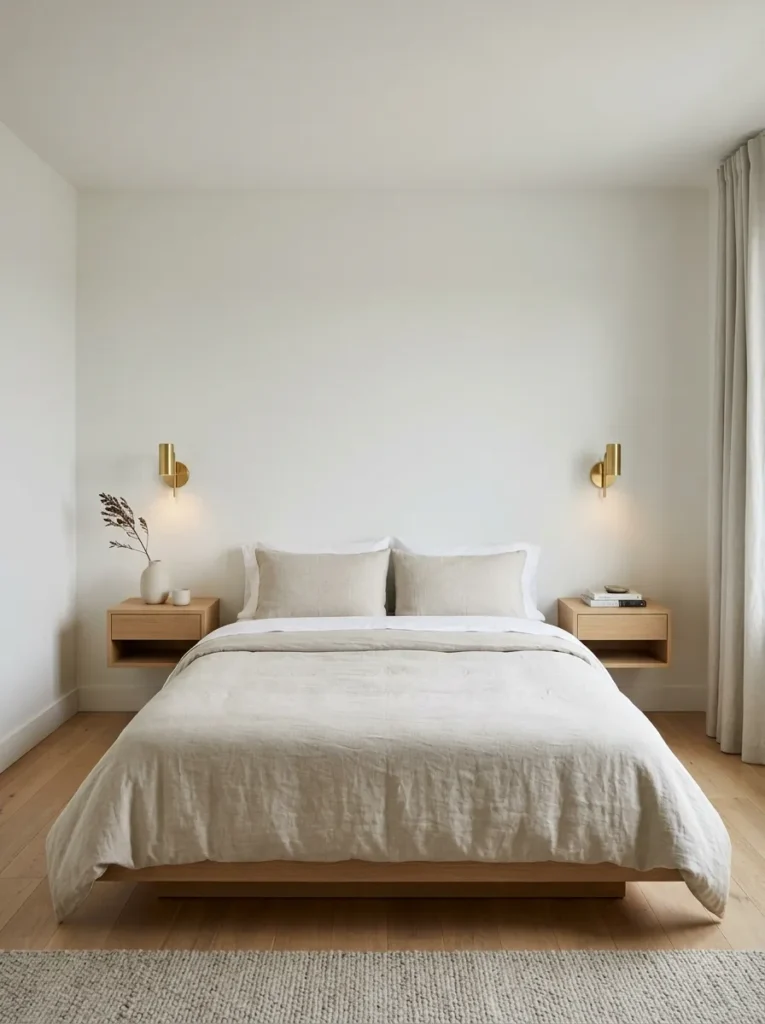
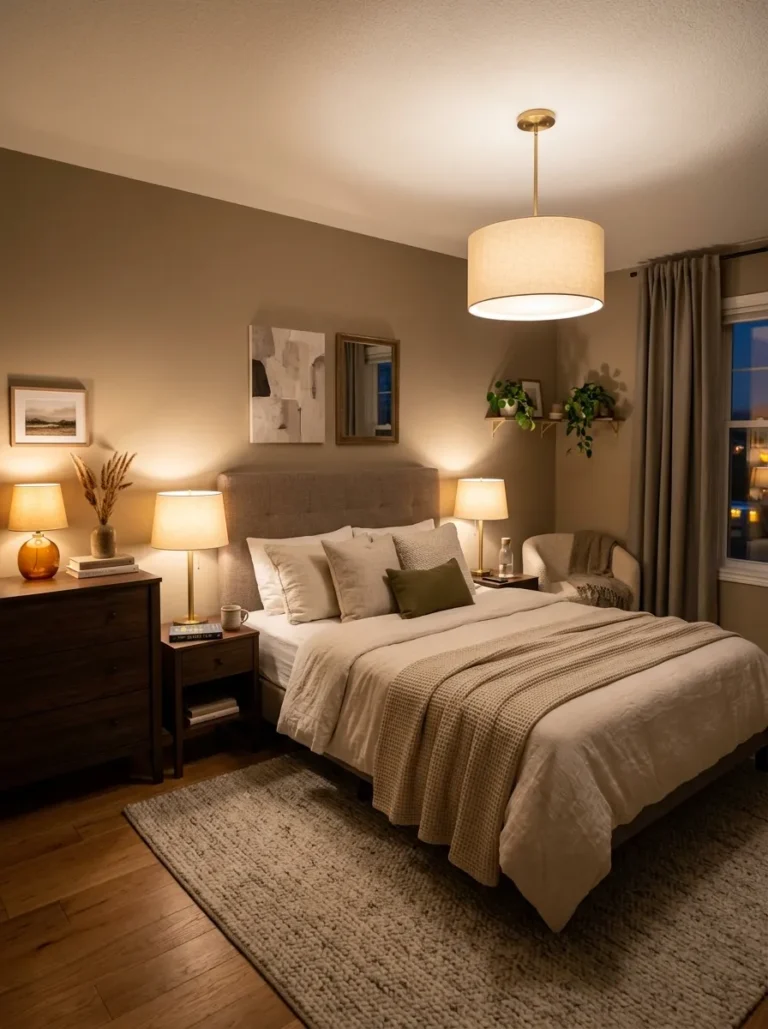
In a shared small bedroom, how the bed is positioned determines everything else — how the room flows, how storage gets distributed, and critically, whether both people feel like they have equal claim to the space. Centering the bed on the longest wall with equal clearance on each side is the foundational move for bedroom ideas for small rooms couples share, because symmetry communicates parity — and parity in a shared bedroom matters more than most design conversations acknowledge.
- Aim for at least 24 inches of clearance on each side of the bed for comfortable movement — 18 inches is the absolute minimum
- A queen bed (60×80 inches) is the sweet spot for most small shared bedrooms — it sleeps two comfortably without consuming the floor plan the way a king does
- Matching nightstands on each side establish visual symmetry and give each person their own dedicated surface — equal territory, zero negotiation required
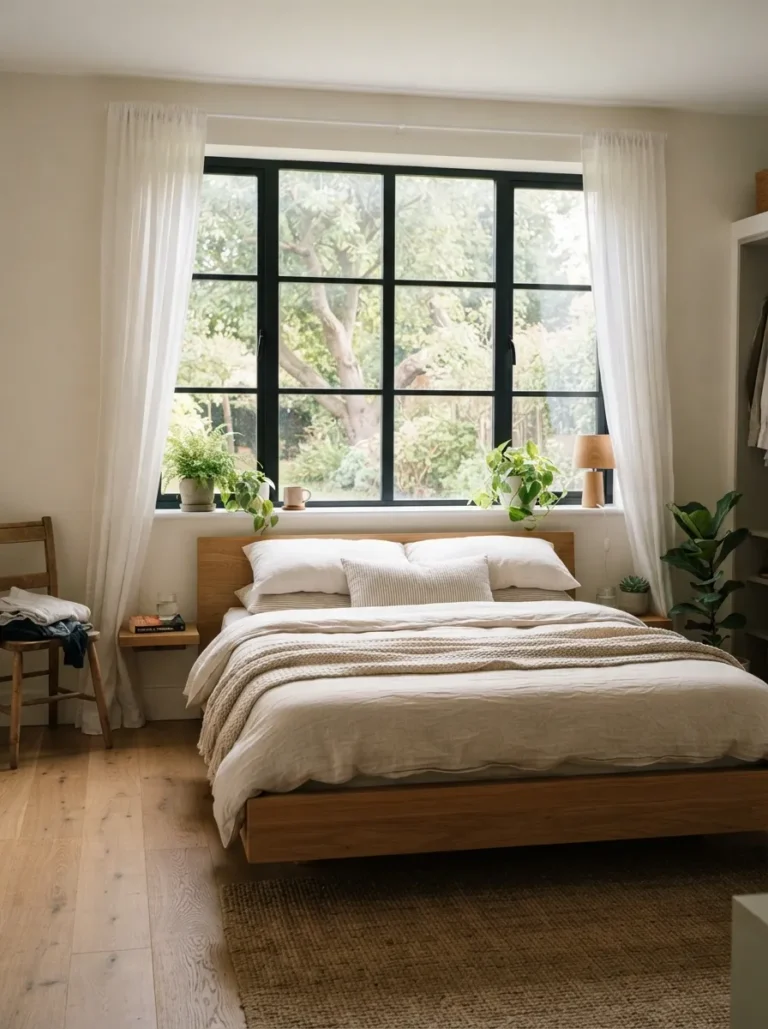
- Low-profile platform beds keep the visual weight minimal, which is essential when the bed is the dominant piece in a compact room
Symmetry in a small bedroom isn’t just aesthetic. It’s the design language of equal partnership.
2. His-and-Hers Storage Zones: Divided but Unified
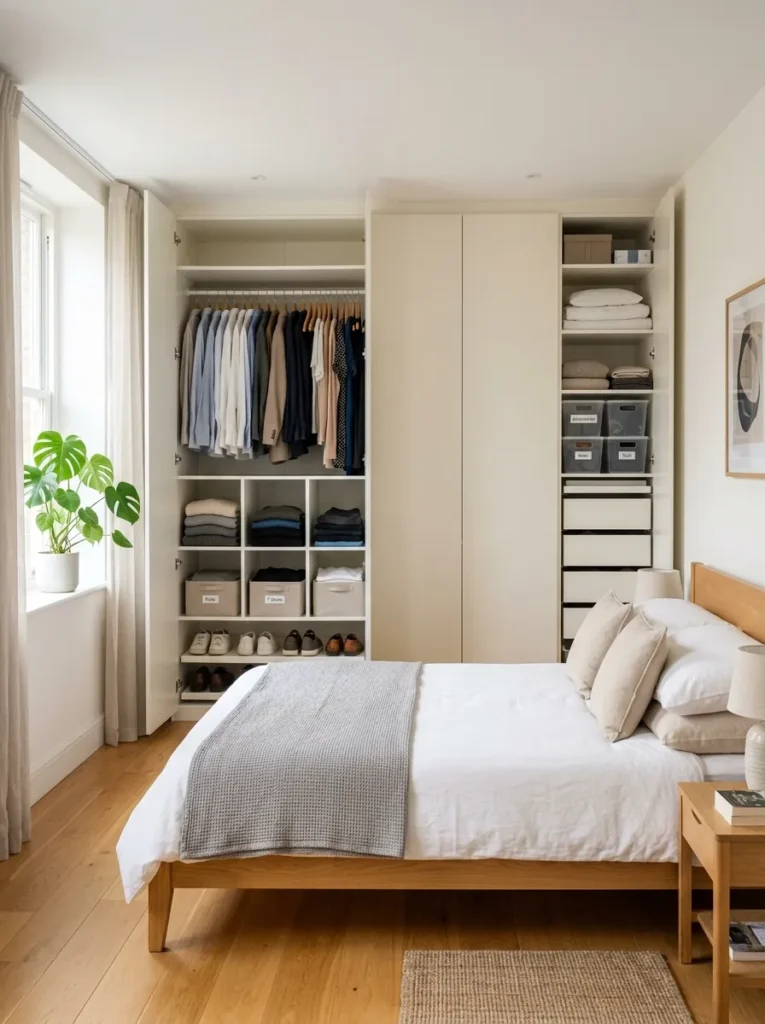
The single greatest source of small bedroom tension for couples is storage inequity — one person’s wardrobe colonizing space the other person needs, or a shared closet that functions on a first-come, first-served basis that somehow always disadvantages the same person. The solution isn’t more storage. It’s defined, dedicated storage zones that give each person clear ownership over their space within the shared system.
- Divide the closet or wardrobe into two equal zones — whether that’s left and right sides, or top and bottom shelving — and commit to the division
- Matching storage containers, hangers, and organizational tools within each zone create visual cohesion even when the contents differ
- For bedrooms without adequate built-in closets, two matching freestanding wardrobes (one per person) placed symmetrically create a fitted wardrobe effect and solve the storage equity problem simultaneously
- Under-bed storage can also be divided: two drawers per side, assigned individually, maintain the equity principle throughout the entire room
- Amazon find: HAUSPROFI Freestanding Wardrobe Closet in White — matching pair creates a his-and-hers symmetrical storage wall without any built-in work
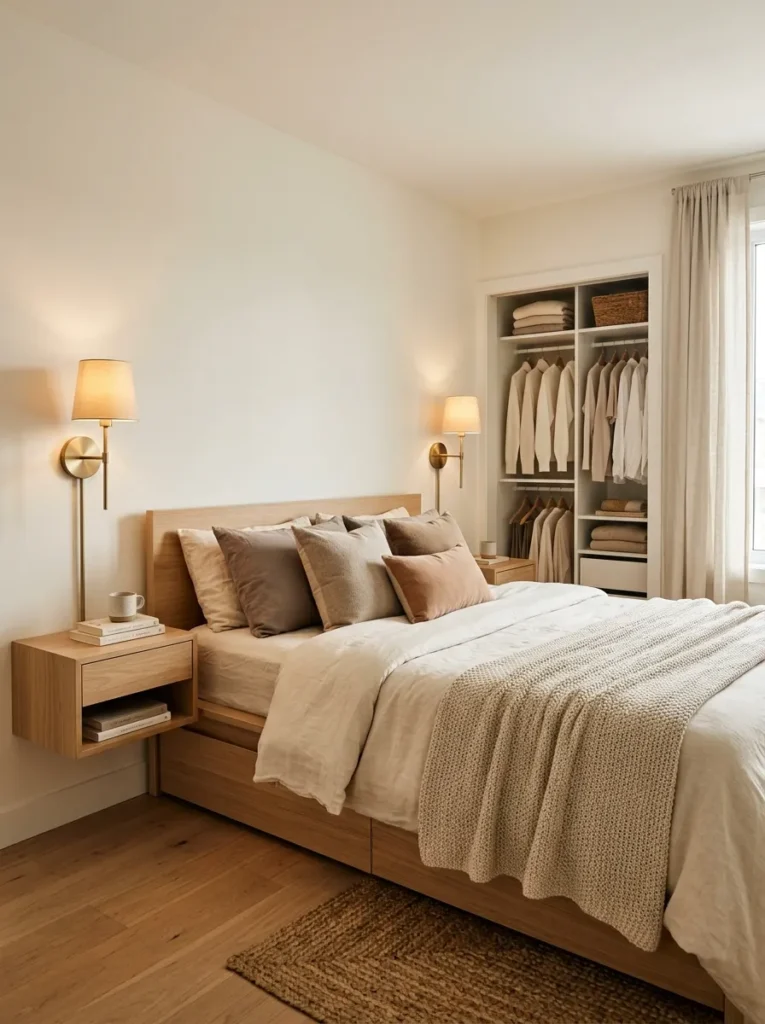
3. Dual Nightstand Lighting: Independent Sleep Schedules, Solved
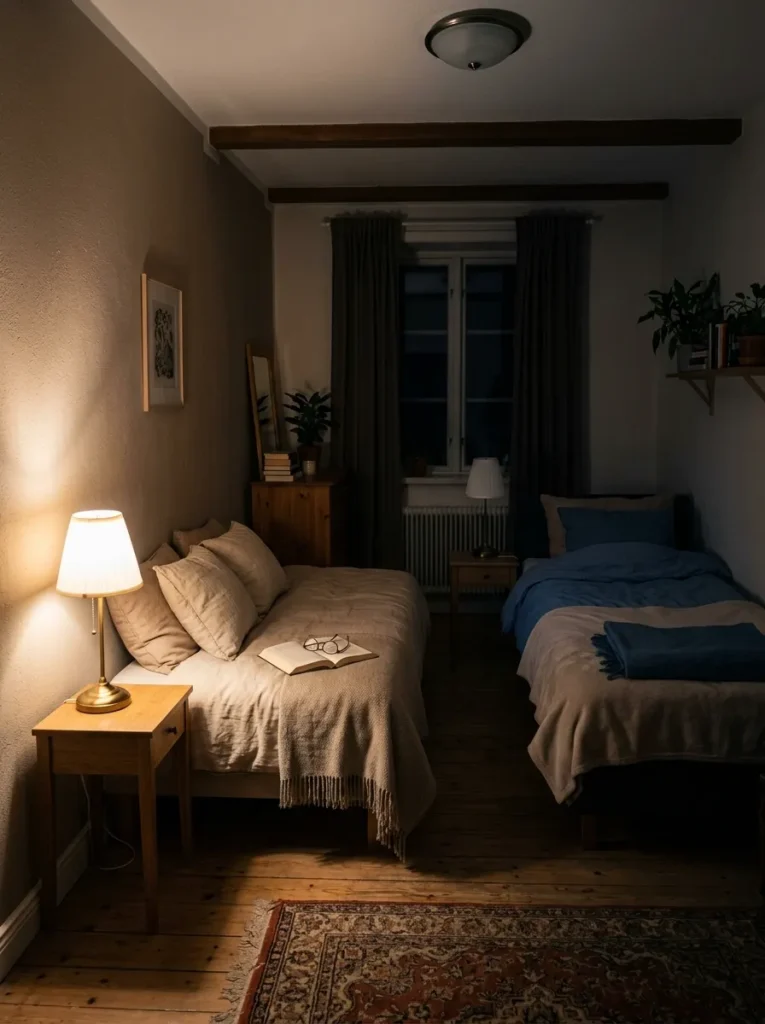
Here is a problem that affects approximately every couple who has ever shared a bedroom: mismatched sleep schedules. One person is a night owl finishing a chapter at midnight. The other has a 6am meeting and was asleep at ten. A single overhead light serves neither of them well — but individual bedside lighting, controllable independently, solves the entire conflict without a single difficult conversation.
- Wall-mounted swing-arm sconces above each nightstand allow one person to read while the other sleeps, with zero light bleed if positioned and shaded correctly
- Plug-in sconces with individual switches are the renter-friendly version — no electrician, no wall fishing, full independent control
- Touch-activated bedside lamps with multiple brightness levels let each person calibrate their light exactly — a feature that sounds minor and transforms nightly routines
- Warm amber bulbs (2200K) on bedside lamps are non-negotiable — cool light at bedtime disrupts sleep for both people in the room, regardless of whose lamp it is
Individual lighting zones in a shared small bedroom are not a luxury. They are a relationship preservation strategy disguised as interior design.
4. A Neutral Shared Palette With Personal Accents
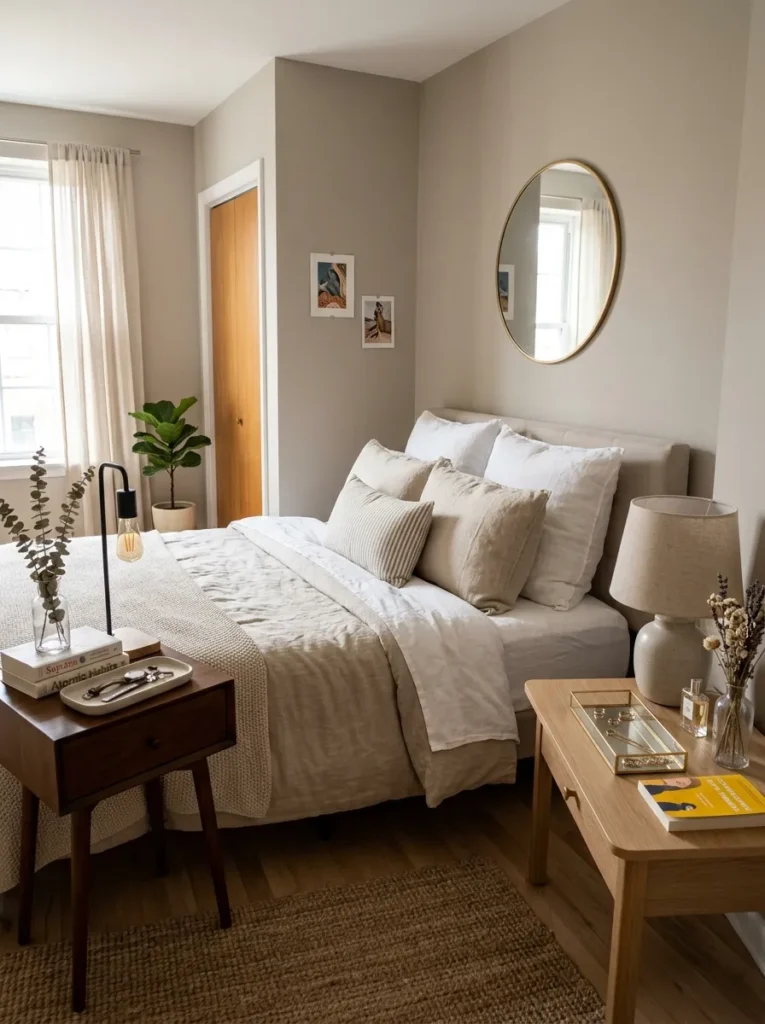
Aesthetic negotiation is one of the more underappreciated aspects of bedroom ideas for small rooms couples navigate — because two people rarely have identical style preferences, and a small bedroom doesn’t have the real estate to accommodate two competing design visions fighting for the same space. The solution is a neutral shared foundation with individual accents — a design framework that gives both people visual representation without creating a room that looks like it’s having an identity crisis.
- Establish a shared neutral palette for the big elements: walls, bedding base, flooring — these belong to both people and should satisfy neither extreme preference
- Allow each person’s nightstand and their side of the bed to express individual style — one minimalist, one warmer and more decorated, both valid
- Shared decor above the bed (a piece of art, a mirror, a wall treatment) should be chosen together — this is the one space that genuinely represents both people
- When style preferences differ significantly, letting texture carry the variation works better than color: masculine and feminine interpretations of warm linen read as cohesive from across the room
A shared bedroom doesn’t require a shared aesthetic. It requires a shared framework — the rest is negotiation, which couples are presumably already good at.
5. Under-Bed Storage: The Square Footage You’re Not Using
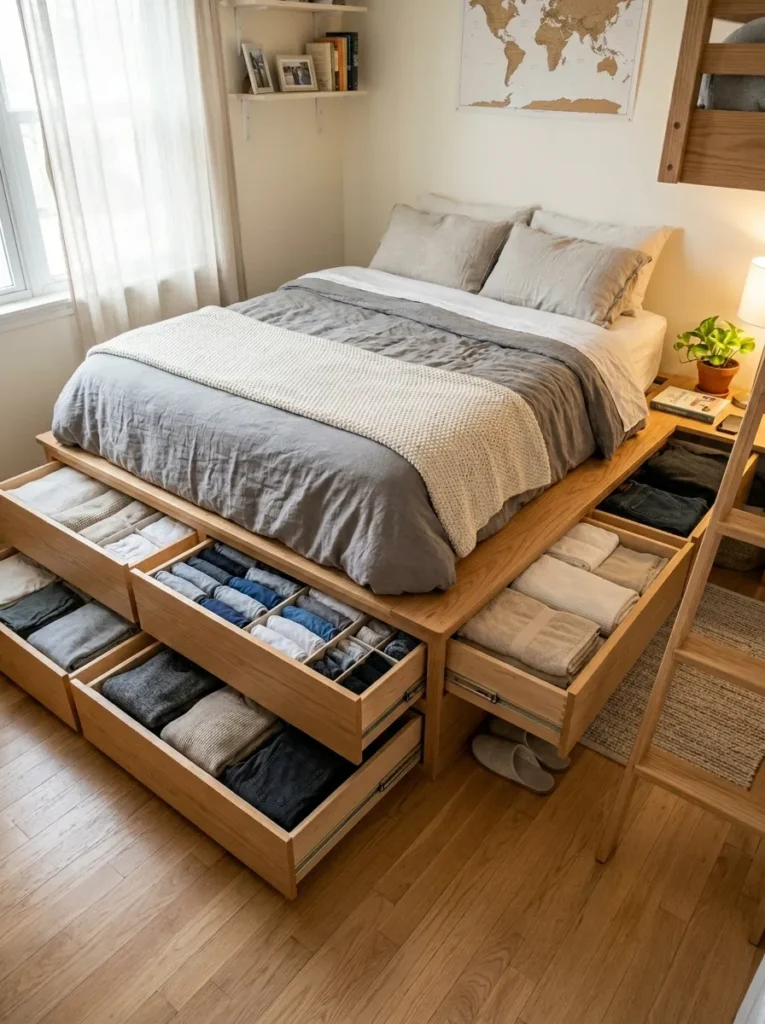
In a small bedroom shared by two people, every square inch of storage capacity is doing important work — and the space under the bed is the most consistently underutilized real estate in the entire room. A queen bed occupies roughly 33 square feet of floor space. That’s 33 square feet of potential storage sitting empty while the closet overflows and the dresser drawers refuse to close. For bedroom ideas for small rooms couples need most urgently, under-bed storage is the immediate answer.
- Platform beds with built-in drawers are the most seamless solution — the storage integrates into the furniture without adding visual weight
- For existing beds without storage, bed risers plus flat rolling bins create the same functional result — less elegant, but immediately effective
- Vacuum storage bags under the bed handle seasonal clothing, extra bedding, and bulky items that consume closet space disproportionately
- Divide under-bed storage by side: each person’s drawers or bins correspond to their side of the bed, maintaining the storage equity principle throughout
The square footage under the bed is not dead space. In a shared small bedroom, it’s the overflow valve that keeps the rest of the room functional.
6. A Room Divider or Curtain: Creating Micro-Privacy When Needed
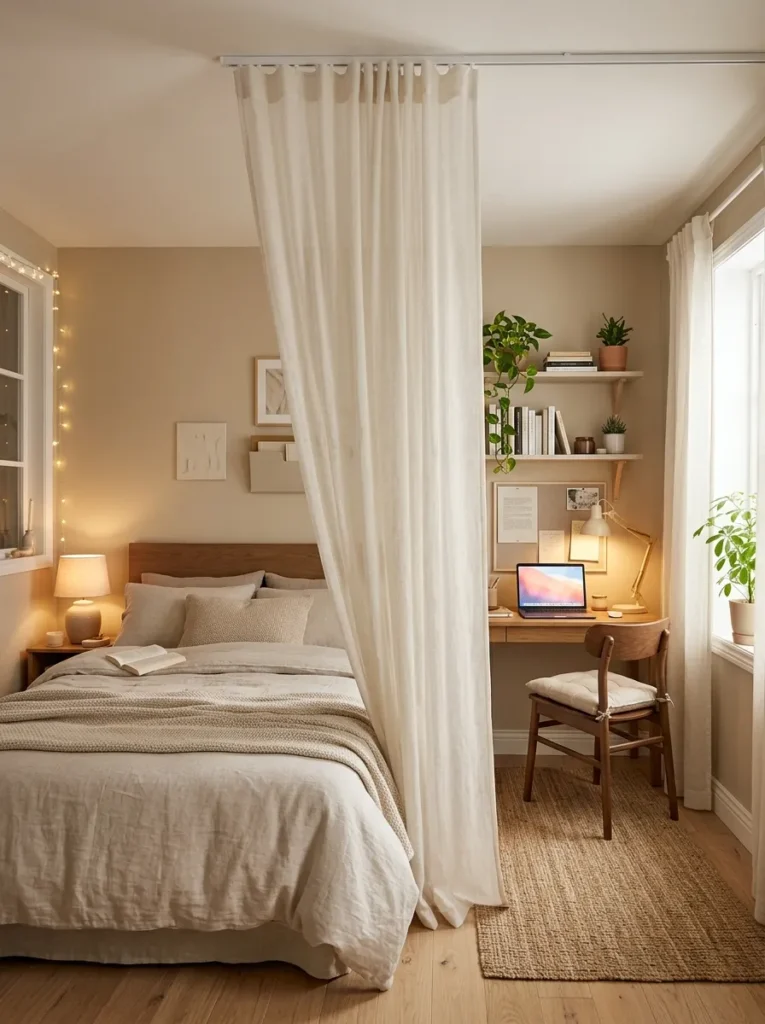
Privacy in a shared small bedroom isn’t about distrust — it’s about sanity. When one person is working late on a laptop and the other needs to sleep, or when one person wants a few minutes of solo space without leaving the apartment entirely, a subtle room division within the bedroom creates micro-zones that serve very different needs within the same footprint. This is one of the most practical and least discussed bedroom ideas for small rooms couples actually benefit from.
- Ceiling-mounted curtain tracks allow sheer linen or fabric panels to divide a bedroom temporarily without any permanent structure
- A partial room divider (bookshelf, open wardrobe, rattan screen) creates visual separation without closing off the space entirely
- Even a simple curtain behind the bed — separating the sleeping area from a small desk or dressing space — can meaningfully improve the functionality of a shared compact bedroom
- For studio apartments where the bedroom is part of a larger open space, this division technique creates genuine bedroom identity within the open floor plan
The ability to close a curtain on the world for fifteen minutes — even a sheer one — is more valuable than it sounds.
This post contains affiliate links. If you buy something through them, I may earn a small commission at no extra cost to you.
7. Mirrored Furniture to Double the Visual Space
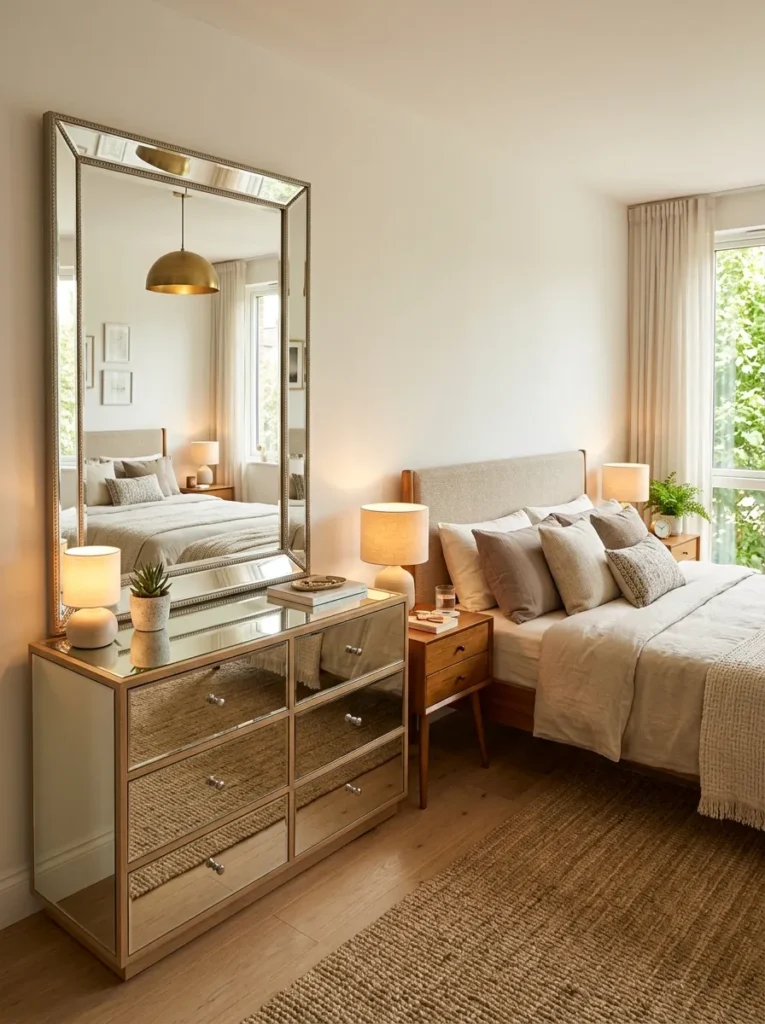
When two people share a small bedroom, the furniture count inevitably increases — more dressers, more nightstands, more organizational pieces — and with it, the risk of the room feeling packed rather than purposefully furnished. Mirrored furniture is the counterintuitive solution: it adds the storage pieces the room needs while simultaneously making the room feel larger, because every mirrored surface reflects light and space rather than absorbing it.
- A mirrored 6-drawer dresser serves double duty as both clothing storage and a large reflective surface — it’s the most functional piece in the room that also makes the room feel twice its size
- Position mirrored furniture opposite or adjacent to the window for maximum light reflection
- Mirrored nightstands on both sides of the bed maintain the symmetry principle while amplifying the effect
- Keep surrounding decor restrained when using mirrored furniture — the reflective surfaces do their best work in a room with some visual breathing room around them
Mirrored furniture in a shared small bedroom is not a design trend. It’s a spatial physics solution with a very attractive finish.
Ensuring equal access to both sides of the bed is crucial for shared comfort, and you can enhance that romantic evening mood by integrating soft romantic bedroom lighting ideas.
8. Shared Charging and Tech Station: Tame the Cable Chaos
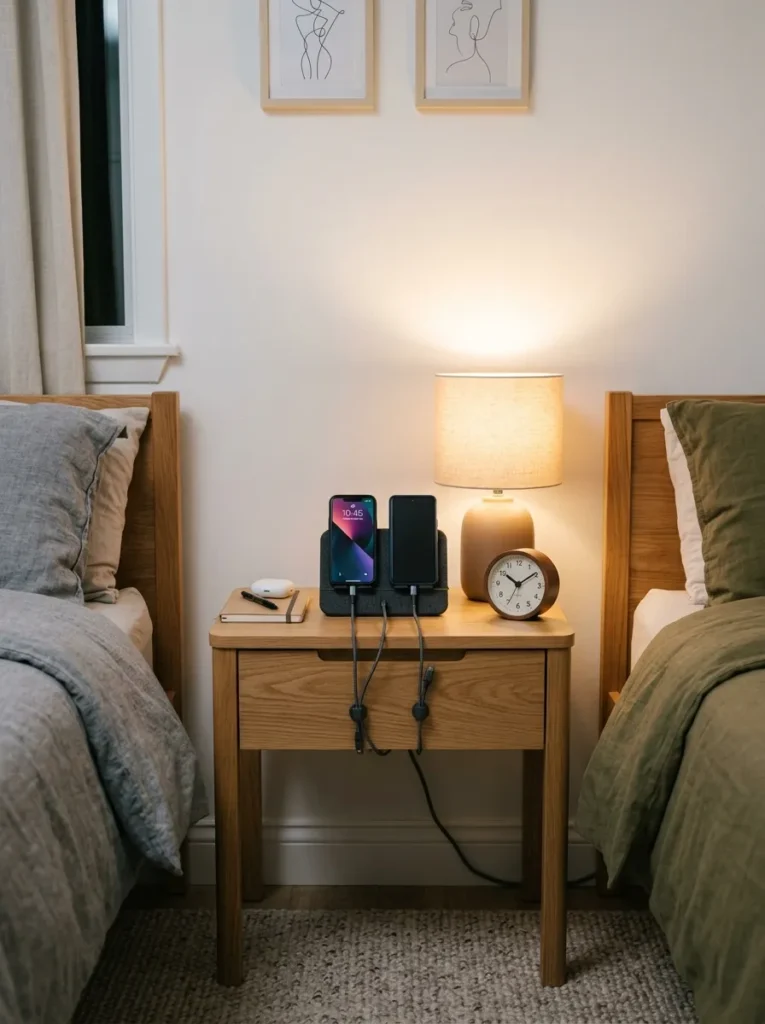
Nobody talks about the cable situation in shared bedrooms. Two phones. Two sets of earbuds. Two kindles or tablets. Possibly two smartwatches. The modern couple generates an impressive amount of bedside technology — and without a system, it generates an equally impressive amount of cable chaos that makes even the most beautifully designed small bedroom look like the back of an electronics store.
- A dual wireless charging pad on one nightstand (or one per side) eliminates the majority of bedside cables in a single purchase
- A bedside charging caddy with multiple USB ports and a cable management channel keeps everything contained, labeled, and accessible
- Recessed wall outlets with USB ports installed at nightstand height are the premium solution — one outlet, no adapters, no visible cables, full function
- Establishing a “no phones on the nightstand” rule and using a small charging station on the dresser instead removes the tech entirely from the sleep zone — a sleep quality decision that’s also a design decision
Two people’s technology in one small bedroom is a solvable problem. It just requires a system — and one conversation about whose charger is whose.
9. A Shared Design Piece That Belongs to Both of You
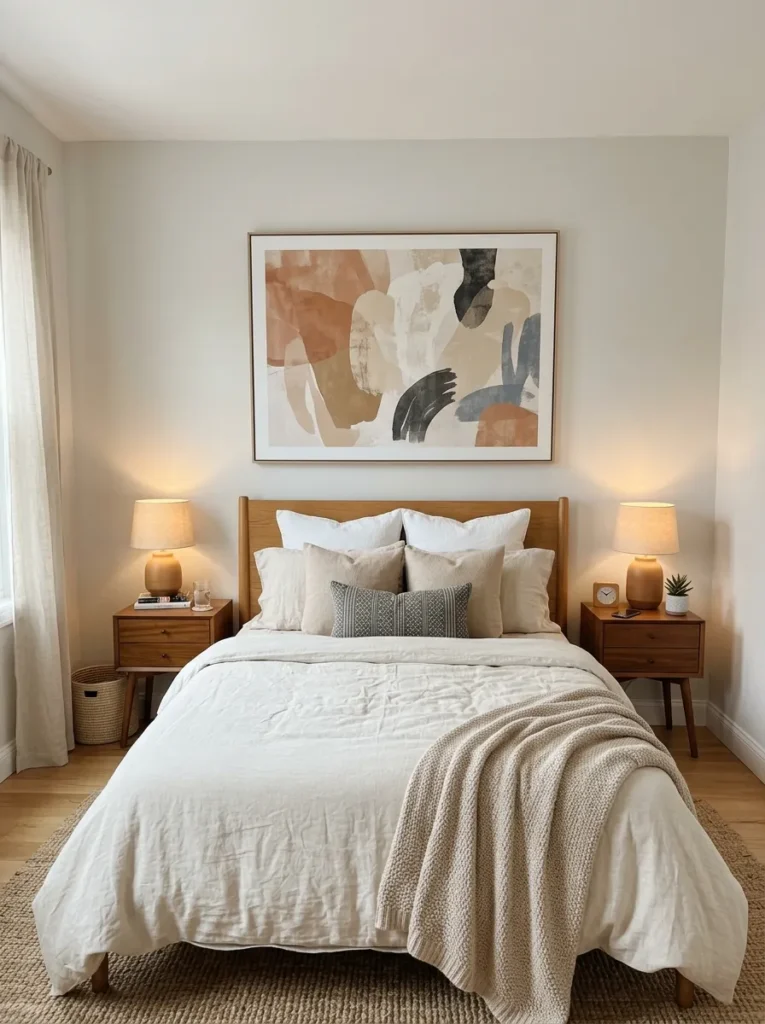
Every bedroom has a focal point — the element that anchors the room visually and communicates something about the people who live there. In a shared small bedroom, that focal point is even more important, because it’s the one design decision that belongs equally to both people… and in a room where everything else has been divided, negotiated, and assigned, having something that’s genuinely shared matters more than any furniture arrangement.
- A large piece of art above the bed (at least 36 inches wide for a queen bed, 48 inches for a king) is the most impactful and most personal focal point a shared bedroom can have
- Choose art together — not by committee compromise, but by finding the one thing that both people genuinely love — this process reveals more about design compatibility than any quiz
- Abstract prints in neutral warm tones tend to bridge aesthetic preferences most successfully — they’re neither overtly feminine nor masculine, and they read differently depending on what surrounds them
- A large framed photo from a meaningful trip or moment is the most personal version of this idea — and in a small bedroom, personal always wins over generic
The shared focal point is the design element that turns two people’s bedroom into one couple’s bedroom. That distinction is everything.
A shared small bedroom doesn’t have to feel like a compromise — it can feel like the most intentional, functional, and genuinely beautiful room in the home when both people’s needs are built into the design from the start. Pick two ideas, implement them together this weekend, and discover what a well-designed shared space does for the hours you spend in it.