9 Mid Century Modern Bathroom Ideas Retro Cool
There’s a moment — usually triggered by scrolling past a perfectly preserved 1957 Palm Springs bathroom — where the desire to have terrazzo floors, a walnut vanity, and a sunburst mirror becomes less of a preference and more of a calling. Mid century modern design has that effect on people. It’s been having that effect on people, continuously, since its original heyday — which is the most reliable sign that an aesthetic isn’t a trend but a genuinely enduring design language. The clean lines, the optimistic colors, the marriage of organic form with geometric precision: it all still looks exactly right, seven decades later.
The challenge with mid century modern bathroom ideas isn’t finding inspiration — every design platform from Houzz to TikTok is well-stocked. The challenge is knowing how to execute the aesthetic without the result looking like a Halloween costume of a 1960s bathroom. The difference between a bathroom that feels authentically mid century and one that looks like a retro prop from a TV set is entirely in the confidence of the application and the quality of the material choices. Authentic MCM design was actually modern for its time — which means the best mid century modern bathroom ideas feel forward-looking, not nostalgic.
Here’s the design principle that separates great mid century modern bathroom ideas from pastiche: the aesthetic is defined by optimism, precision, and the belief that good design should be available to everyone. It’s democratic, joyful, and structurally honest. A walnut vanity with tapered legs isn’t farmhouse — it’s a structural statement. A terrazzo floor isn’t retro kitsch — it’s an early form of sustainable, infinitely durable material. Understanding the why behind the design elements makes the execution feel confident rather than costume-y.
These 9 mid century modern bathroom ideas will bring the iconic design language of the 1950s and 60s into a contemporary bathroom with the kind of conviction that makes the aesthetic look like the most natural thing in the world.
Let’s jump into the ideas that make a bathroom feel like it was designed when optimism was still America’s default setting.
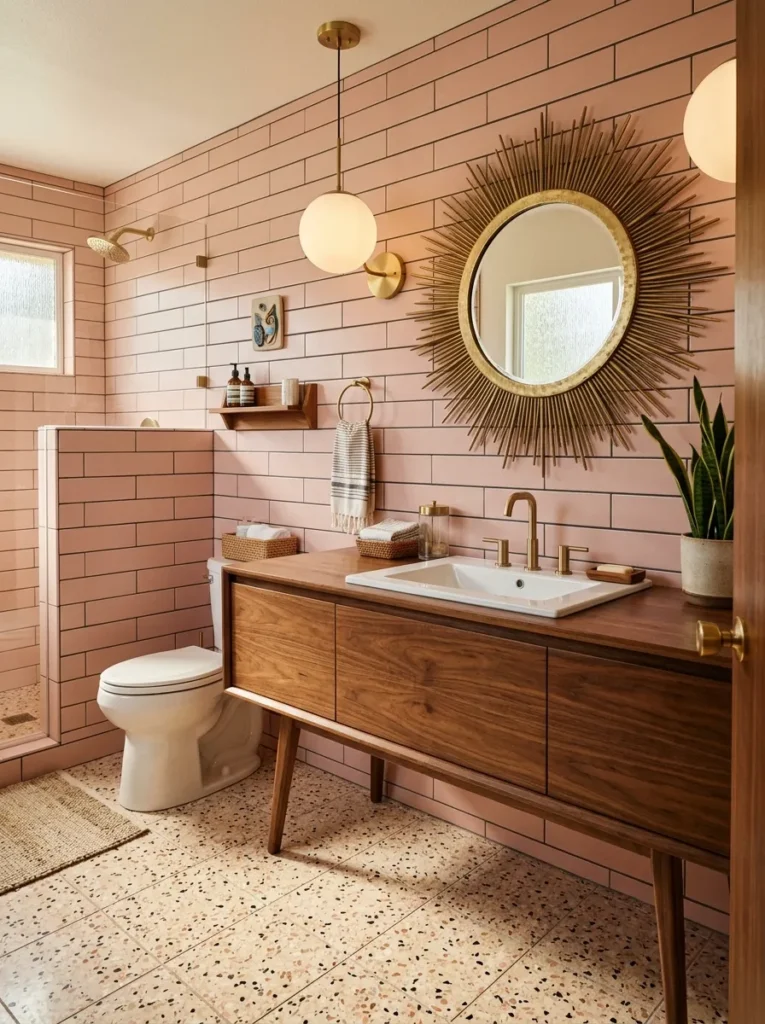
1. Terrazzo Floors — The MCM Material That Never Left
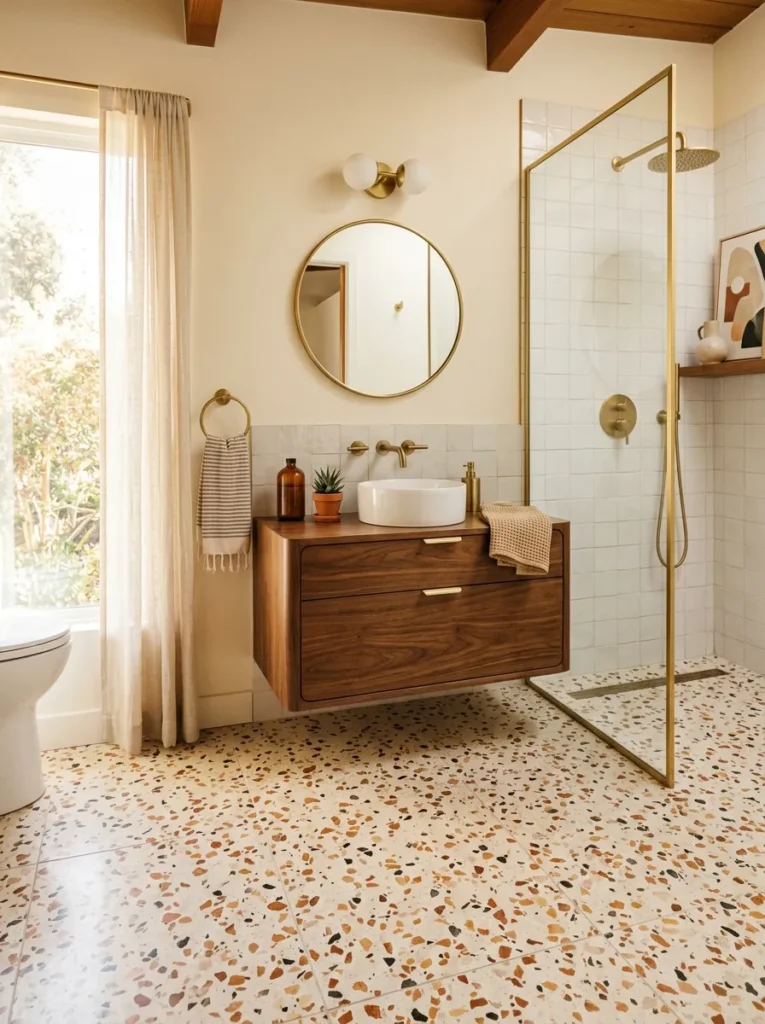
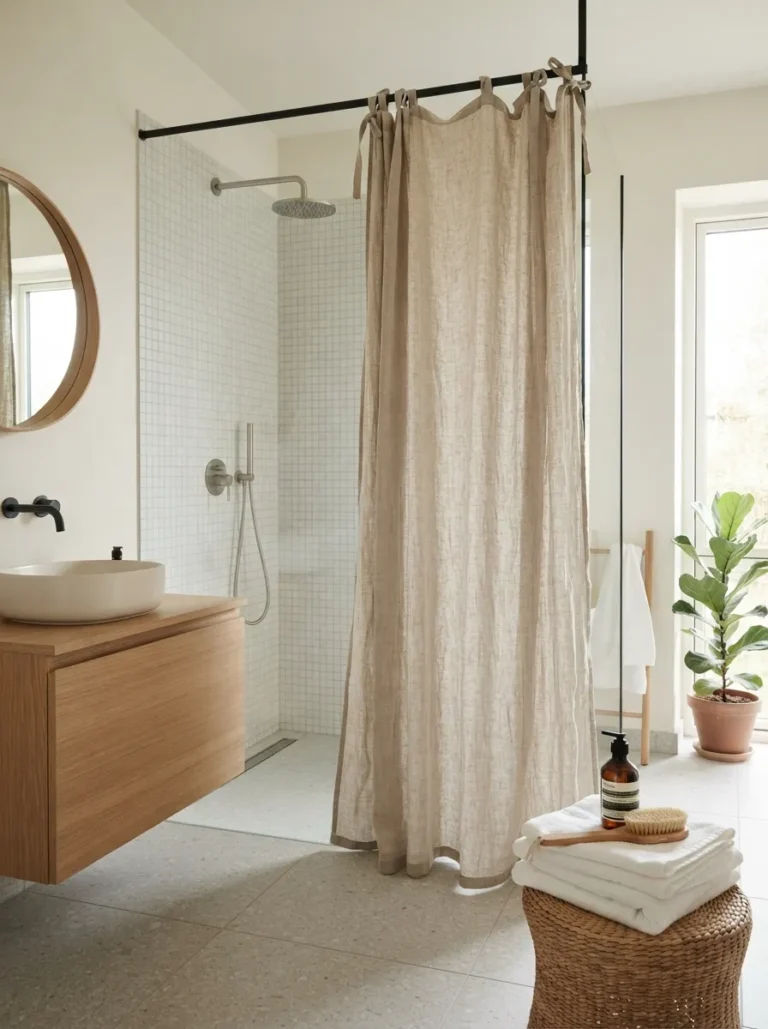
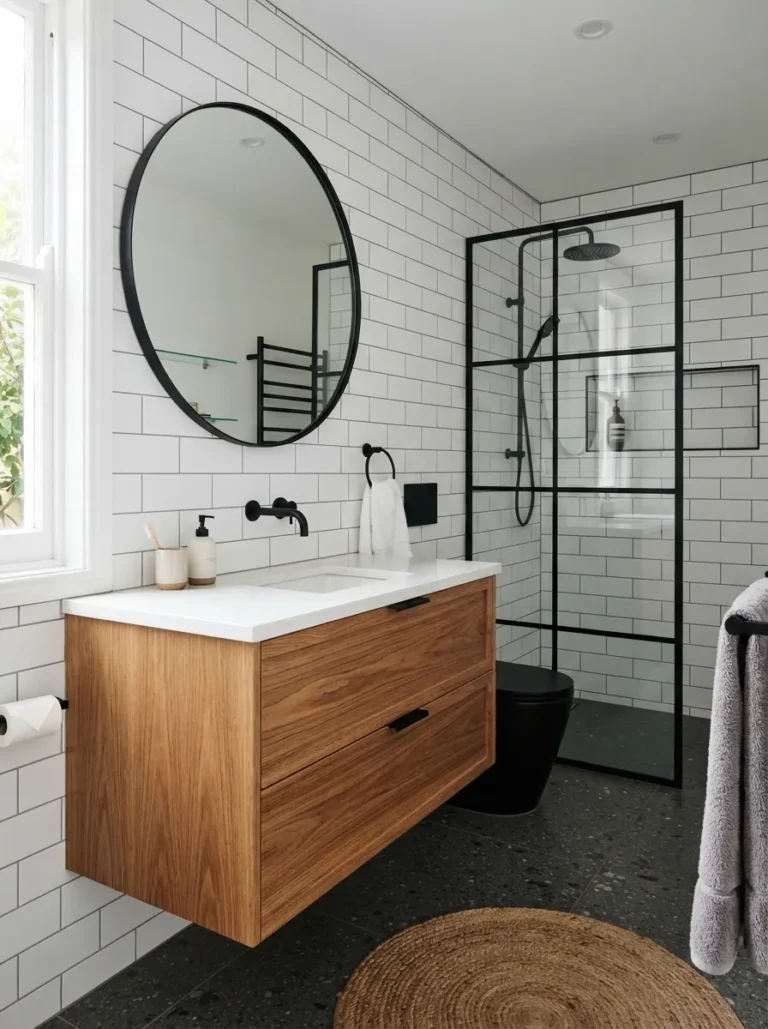
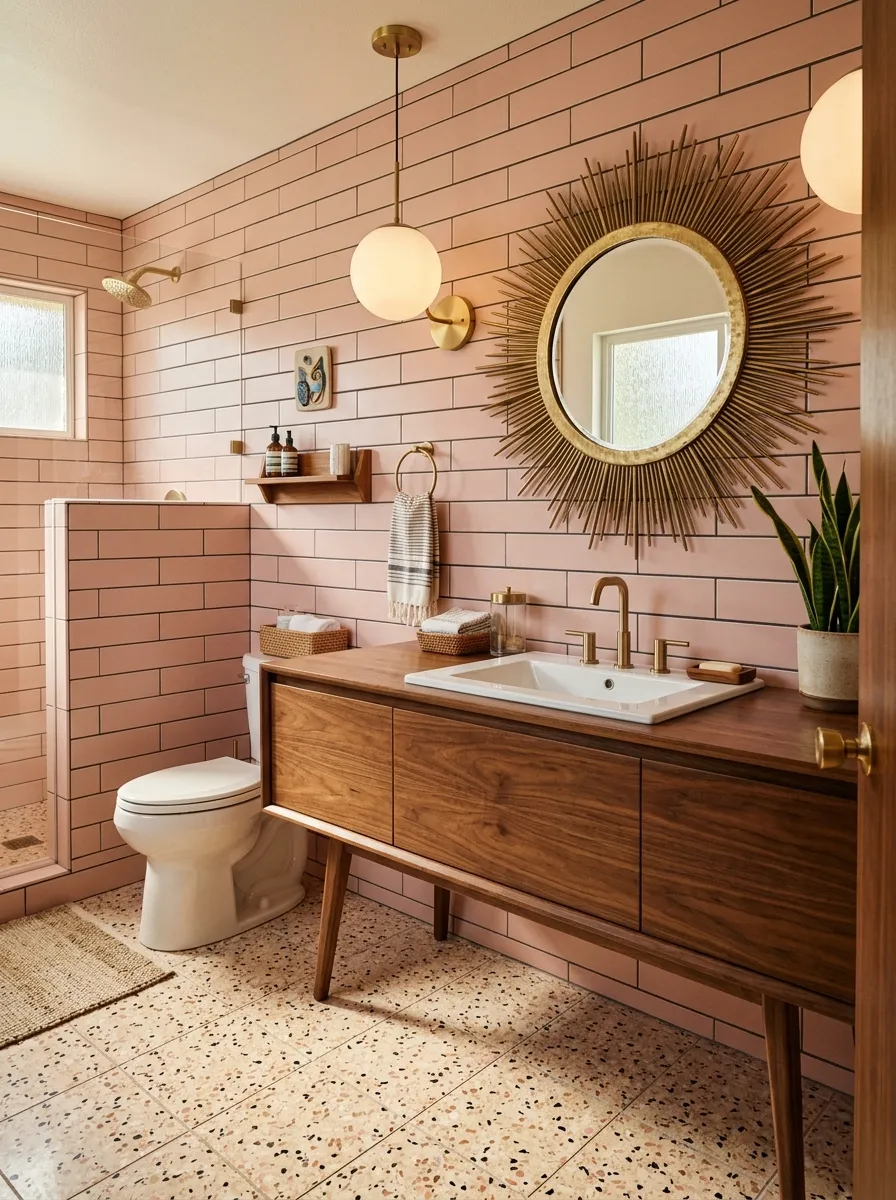
If terrazzo has a design era, it’s mid century — and if mid century modern bathroom ideas have a non-negotiable floor material, it’s terrazzo. The aggregate composite of marble, granite, and glass chips set in a cement or epoxy binder was the flooring of choice for modernist architects from Palm Springs to Milan, and it’s been rehabilitated from “dated school hallway” to “design-forward statement” in a way that is thoroughly, completely deserved. Terrazzo is genuinely extraordinary material: durable, unique in every installation, and visually stunning.
- Warm terrazzo palettes for MCM bathrooms: cream with terracotta and gold chips, white with pink and gray, sage green with white and brass
- Porcelain terrazzo-look tiles are a more accessible option — current technology produces terrazzo-effect tiles nearly indistinguishable from genuine poured terrazzo
- Extend terrazzo from the floor up a low wainscoting section for a fully committed MCM statement
- Larger aggregate chips (more visible, more graphic) read as bolder and more contemporary; finer chips read as more vintage-authentic
Terrazzo is the floor material that survived the design revolution of every decade since the 1950s. That’s not luck. That’s timelessness.
2. A Floating Walnut Vanity With Tapered Legs
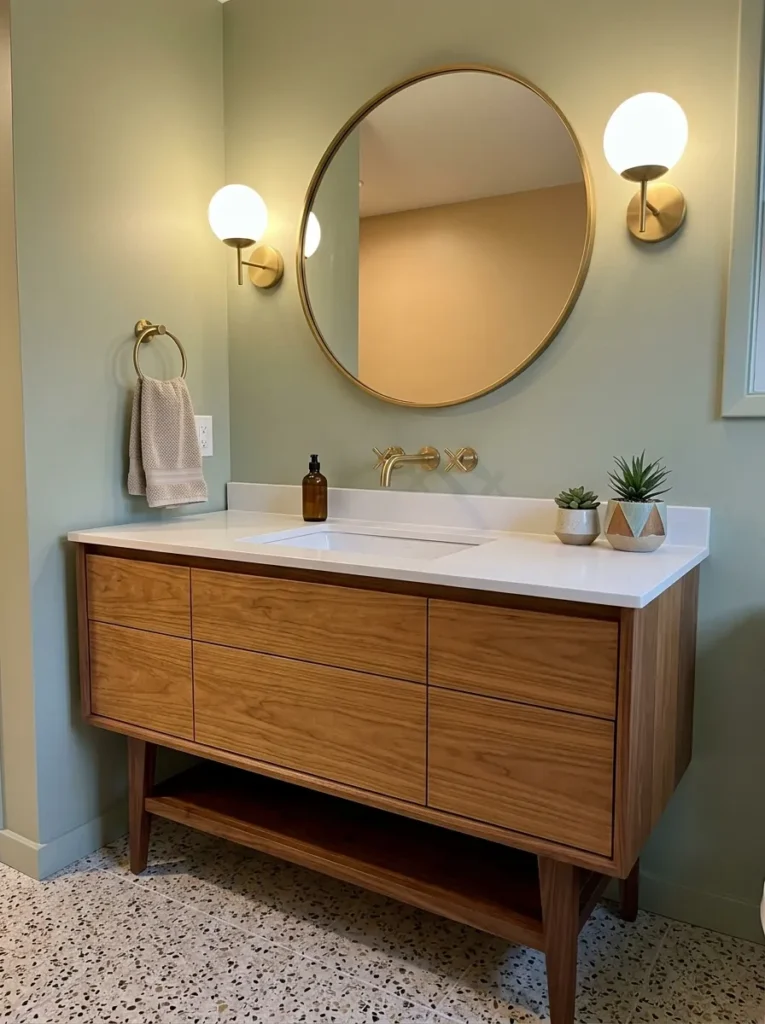
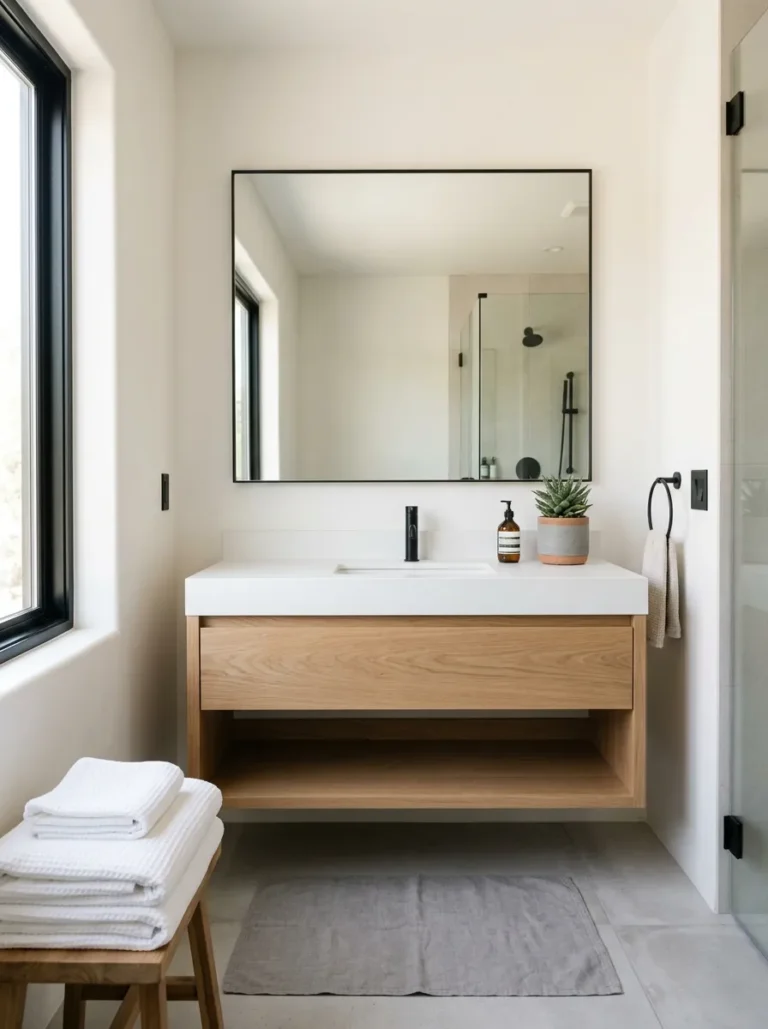
No single piece of furniture communicates “mid century modern” more immediately than a walnut vanity with tapered legs. It’s the design shorthand of the entire era — warm wood, honest construction, legs that express the furniture’s structure rather than hiding it. In a bathroom, this vanity doesn’t just look right: it feels right, bringing a warmth and material authenticity that white box vanities categorically cannot provide.
- Flat-front (slab) drawer fronts are the most authentically MCM profile — avoid shaker panels, raised panels, or decorative molding
- Walnut’s warm, dark grain is the canonical MCM wood tone; lighter teak works for a warmer, more Danish-inflected version
- Tapered or angled legs in solid wood or brass are the structural detail that makes the furniture recognizably mid century
- Pair with a wall-mounted brass faucet to keep the countertop clean and the material story cohesive
This vanity is the furniture piece that makes every other bathroom choice suddenly make perfect sense. Start here — everything else follows.
3. Geometric or Hexagonal Tile in a Bold Color
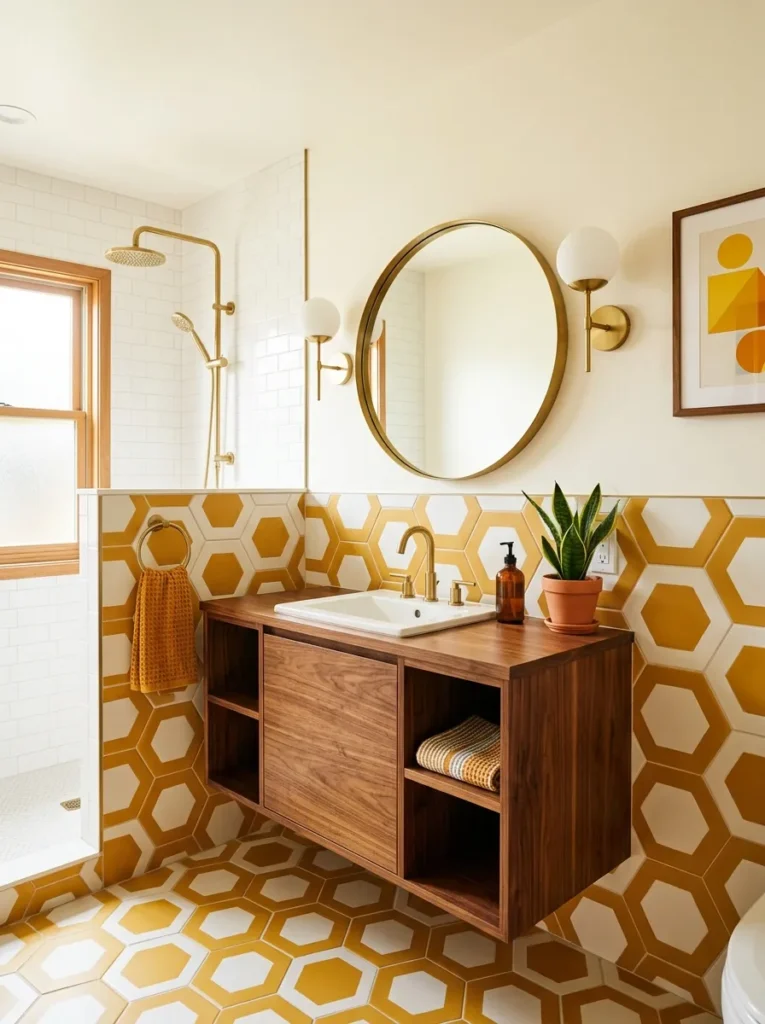
Mid century modern design was not afraid of color — and mid century modern bathroom ideas that play it entirely safe with neutral palettes miss one of the aesthetic’s most joyful qualities. Geometric tile in a confident color (avocado, mustard, turquoise, warm pink, sage green) is the bathroom element that signals “this designer knew exactly what they were doing” with the kind of retro cool that reads as completely contemporary in 2026. The geometry references the atomic age; the color references the optimism.
- Hexagonal tile in a two-tone pattern (color + white) is the most versatile geometric MCM tile choice
- Penny round tiles, chevron, and elongated hex all reference the era’s affinity for geometric pattern
- Apply bold-colored tile to the shower wall or as a feature floor rather than all surfaces — one graphic statement, consistently executed
- Dark grout in a contrasting tone sharpens the geometric pattern — use charcoal with white tile, warm gray with mustard
A bathroom that commits to bold geometric tile is not a bathroom that plays it safe. That distinction, in mid century modern design, is entirely the point.
4. A Sunburst or Starburst Mirror in Brushed Brass
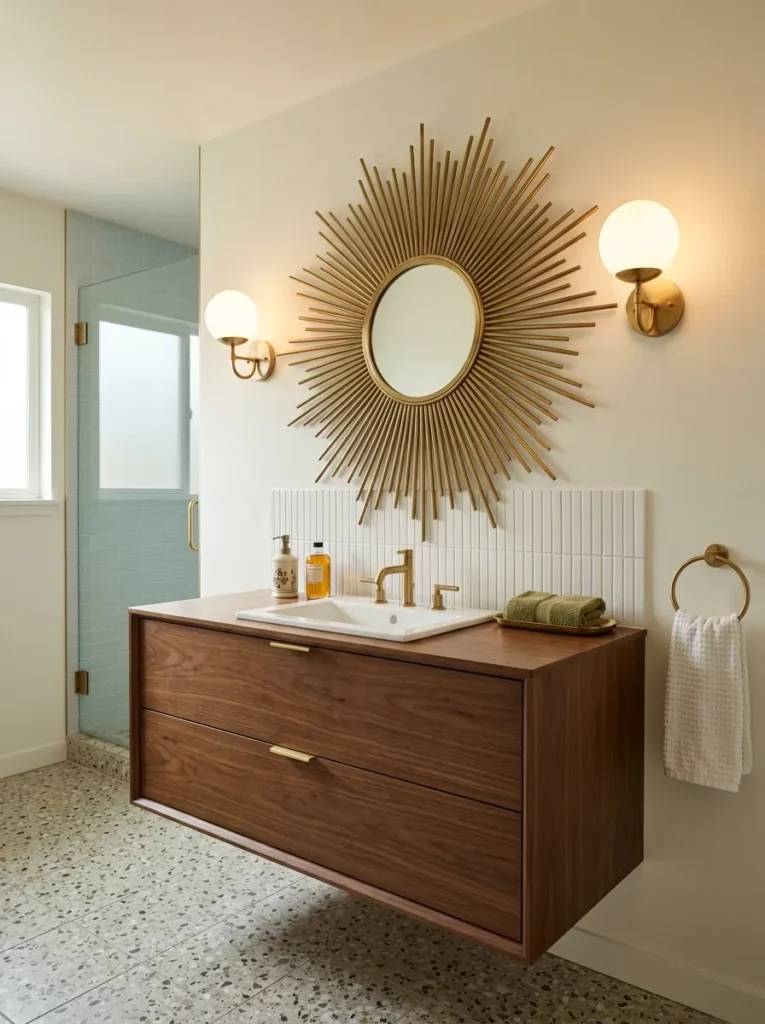
The sunburst mirror is the mid century modern bathroom’s most iconic single accessory — the piece that crystallizes the era’s visual language in a single wall-mounted object. Those radiating brass spokes reference the atomic age’s fascination with energy, radiation, and the optimistic symbolism of the sun. In a bathroom, it’s both practical (a large reflective surface that bounces light) and purely aesthetic (the MCM statement piece that costs less than a new faucet).
- Brushed brass is the most authentically MCM finish — polished gold reads as glamorous, antique brass reads as traditional, but brushed or satin brass reads as precisely 1958
- Size matters: a sunburst mirror at 30–36 inches in diameter commands the wall above a vanity; smaller ones get lost
- The mirror works best against a plain, light-colored wall — it needs visual quiet around it to register as a statement
- Pair with globe sconce lights flanking the mirror for the full MCM bathroom vanity vignette
The sunburst mirror is the mid century modern bathroom piece that non-design people call “that cool starburst thing” and design people call “essential.” Both groups are correct.
5. Globe Pendant Lights or Sputnik-Style Sconces
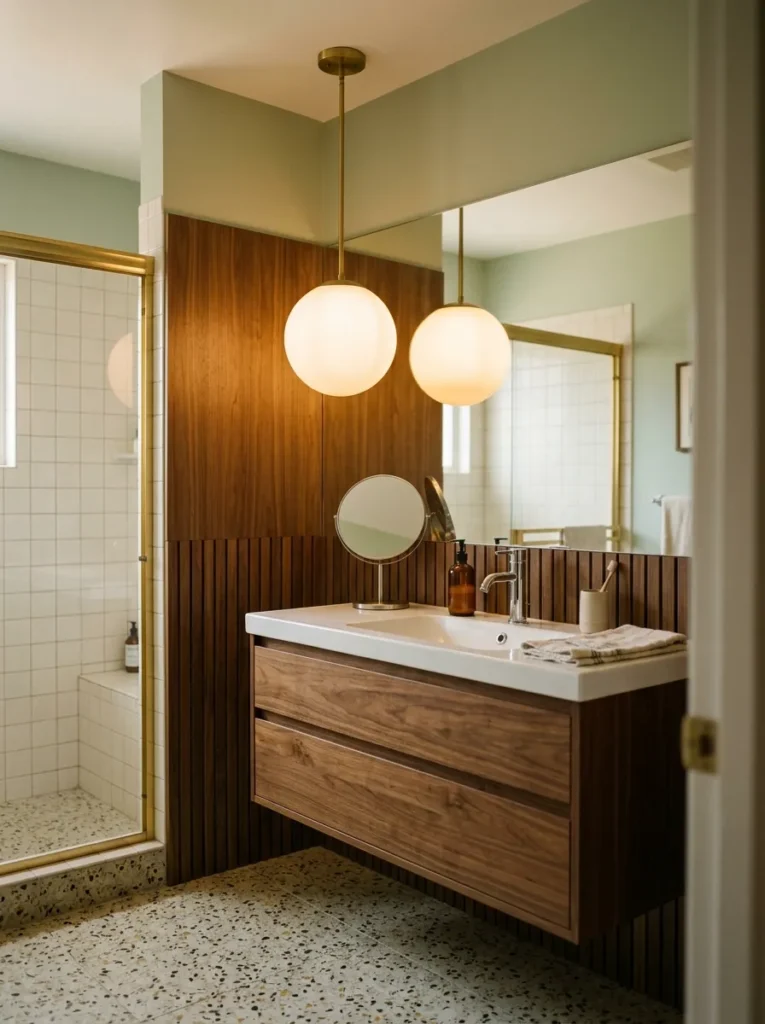
Globe pendant lights and Sputnik-style sconces are the lighting fixtures that time-stamp a bathroom as mid century with the same confidence a Eames chair time-stamps a living room. The globe — whether in frosted white glass, amber glass, or clear — references the era’s obsession with spherical, atomic forms. The Sputnik sconce, with its multi-armed brass or chrome spokes, is practically an artifact of space-race optimism. Both belong in a mid century modern bathroom the way disco belongs in the 1970s — unmistakably, joyfully, completely.
- Frosted glass globes in warm white or amber produce the most flattering bathroom lighting
- Mount globe pendants above the vanity at 6–7 feet for adequate clearance and correct visual proportion
- Sputnik sconces flanking the mirror provide both task lighting and the mid century aesthetic statement simultaneously
- Brass or polished chrome are both authentic period-appropriate finishes for MCM lighting fixtures
The right light fixture transforms a bathroom from “inspired by mid century” to “genuinely of that world.” That transformation happens in the shape of the shade.
Tapered legs on walnut vanities and geometric brass light fixtures capture beautiful retro nostalgia, which can be effortlessly modernized with updated modern bathroom mirror ideas.
This post contains affiliate links. If you buy something through them, I may earn a small commission at no extra cost to you.
6. Avocado, Mustard, or Teal Accent Color
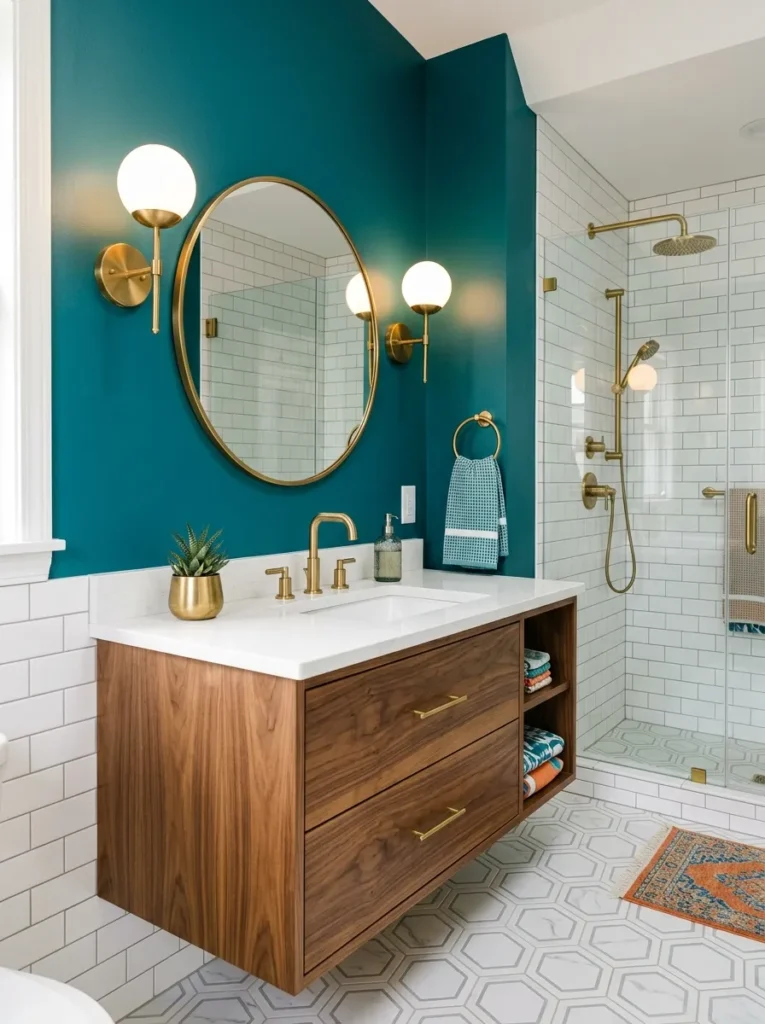
One of the defining pleasures of mid century modern bathroom ideas is the permission to use color without apology. The era’s palette — avocado green, harvest gold, harvest mustard, coral pink, and teal — is currently undergoing the same full rehabilitation that shag carpet has not. These colors are no longer “dated”: they’re “period-correct,” and applied in a contemporary context with modern fixtures and materials, they read as bold, confident, and genuinely sophisticated.
- Use the saturated accent color on a single wall (the vanity wall or the shower wall) rather than all surfaces
- Avocado and sage green: the most contemporary-reading MCM colors in 2026, bridging mid century and organic modern palettes simultaneously
- Mustard gold: the warmest, most immediately retro choice — pair with walnut and white for maximum MCM impact
- Teal and turquoise: the boldest option — pair with brass fixtures and white tile for a Palm Springs-inflected aesthetic that photographs extraordinarily well
Committing to an MCM color in a bathroom is the decision that separates a bathroom that “references” mid century from one that actually lives there.
7. Teak Wood Accessories and Atomic-Era Accents
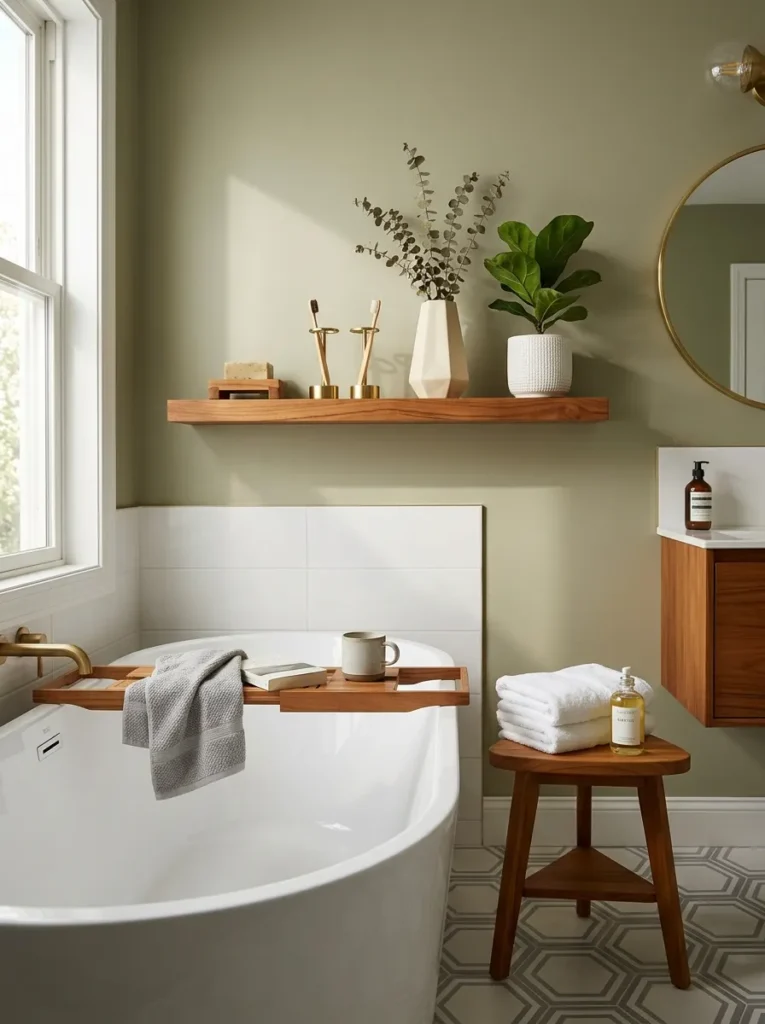
Mid century modern design celebrated the marriage of natural materials and precise form — and nowhere is that more achievable at the accessory level than teak. Teak bath accessories (soap dishes, bath trays, small stools, shelf organizers) have been a staple of Scandinavian bathroom design since the 1950s, and they bring the period’s warmth and material honesty into a bathroom for a relatively modest investment. Paired with geometric ceramic accents and brass holders, they complete the mid century modern bathroom story from macro to micro.
- Teak is naturally moisture-resistant — unlike most woods, it genuinely belongs in a bathroom environment without special sealing
- A teak bath tray across a freestanding or built-in tub is the MCM bathroom accessory with the highest visual-to-cost ratio
- Geometric ceramic vessels (angular, asymmetric, or spherical) reference the era’s love of sculptural form
- A small Eames-era style stool beside the tub or beside the vanity pulls the furniture language of the era into the bathroom space
The teak accessory is not vintage decor. It’s the mid century modern bathroom’s operating material — used then, still beautiful now, still correct for exactly the same reasons.
8. Pink or Colored Bathroom Fixtures — The MCM Bathroom’s Bravest Move
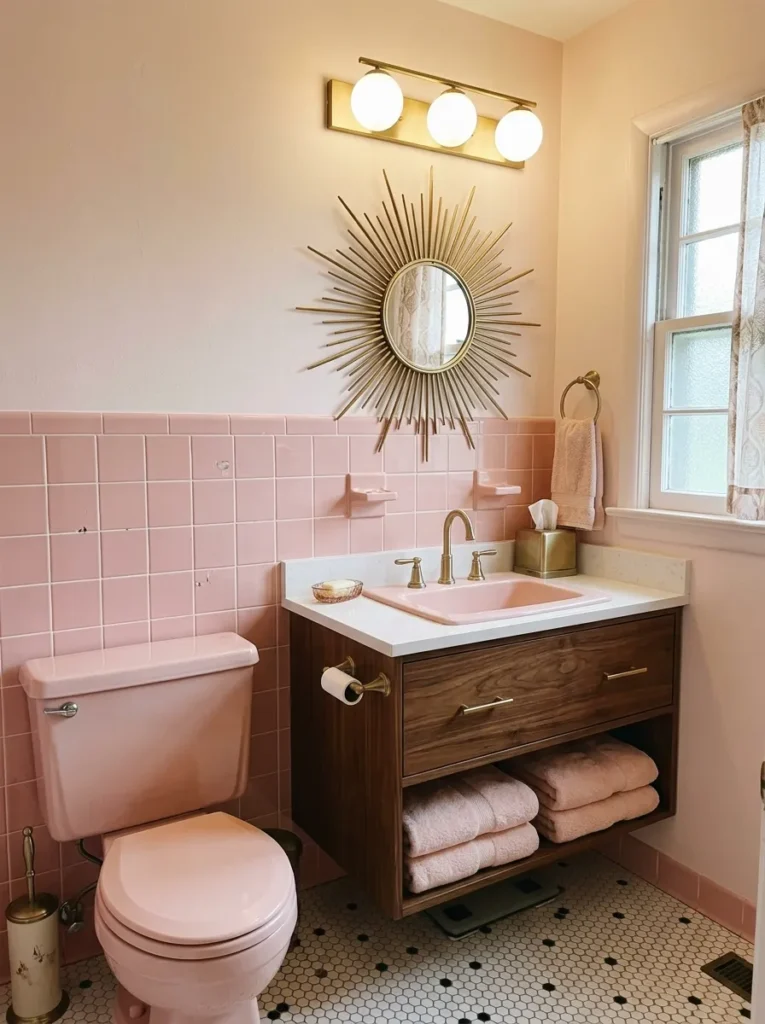
Here’s the mid century modern bathroom idea that requires the most courage and delivers the most authentic result: colored fixtures. Pink sinks, avocado toilets, turquoise bathtubs — these were the apex expressions of MCM bathroom confidence in the 1950s and 60s, and they are absolutely, completely, wholeheartedly back. The “Pink Bathroom Revival” is real, documented, and gathering momentum — and the homeowners leading it are not doing it ironically. They genuinely love it. Because it’s genuinely beautiful.
- Colored bathroom fixtures are now available from specialty manufacturers and increasingly from mainstream suppliers as the trend grows
- Original 1950s–60s colored fixtures appear regularly on architectural salvage marketplaces — often in perfect condition, because the ceramics from that era were extraordinarily well made
- Pink, avocado, and turquoise are the three most authentic MCM fixture colors — each reads differently against the surrounding palette
- If colored fixtures feel too committed, a colored freestanding bathtub (in a room with otherwise white fixtures) is a more considered entry point
The pink bathroom is not a mistake from the past that someone preserved. It’s a design choice that was right then, was unfairly maligned in the renovation era, and is emphatically right again. Welcome back.
9. Atomic-Era Wallpaper or Geometric Wall Mural
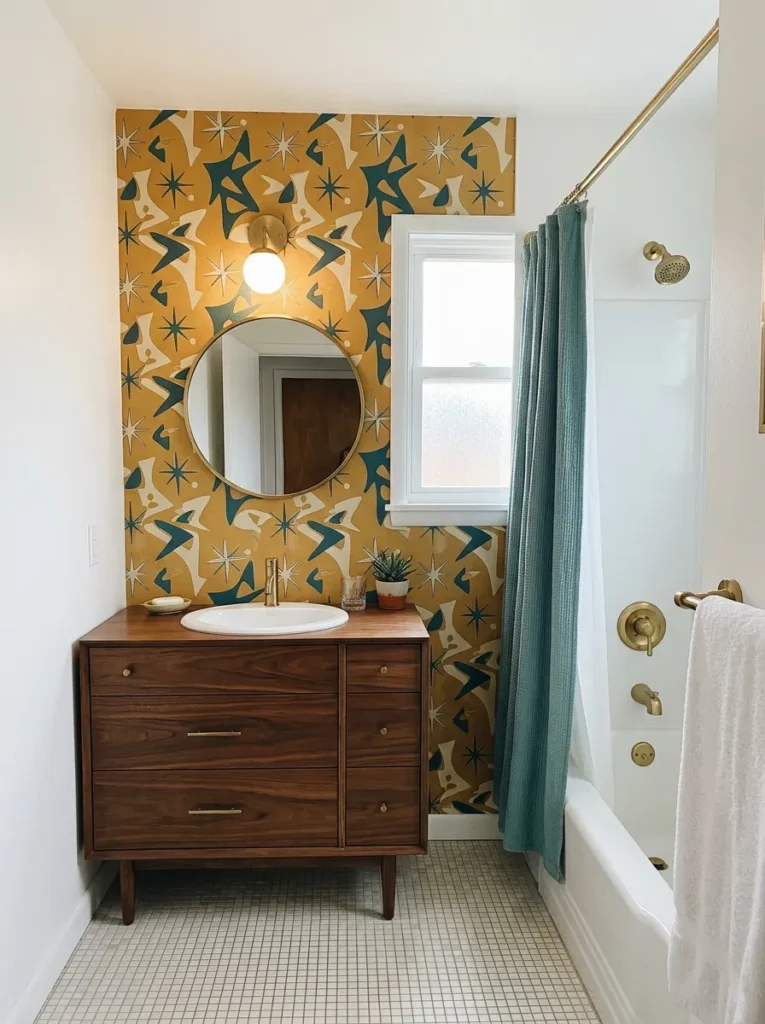
The atomic age’s graphic design vocabulary — starbursts, boomerangs, kidney shapes, amoeba forms, molecular diagrams rendered as decoration — is one of the most recognizable and most joyful visual languages of the 20th century. Applied as wallpaper on a single bathroom accent wall, an atomic-era pattern does something that paint and tile alone cannot: it immediately, unmistakably, joyfully announces that this is a mid century modern bathroom. No equivocating, no hedging — just the confident graphic language of an era that believed design could make people happy.
- Apply to the vanity wall or the wall behind the toilet — a single wallpapered surface, surrounded by plain walls and anchored by period-appropriate fixtures, is always more impactful than wallpaper everywhere
- Atomic-era patterns in warm mustard-and-cream, teal-and-white, or coral-and-gray are all available from specialty vintage reproduction wallpaper manufacturers
- Peel-and-stick atomic-era wallpaper options make this completely renter-friendly and commitment-free
- The scale of the pattern matters: large-scale atomic motifs on a small bathroom wall read as bold; small-scale repeating patterns read as textile-like and sophisticated
Atomic-era wallpaper is the mid century modern bathroom’s declaration: yes, this was intentional, yes, it’s 1957 in here, and yes — it looks extraordinary.
Mid century modern bathroom ideas don’t require a time machine — they require the confidence to commit to a design language that understood beauty, function, and optimism before those things became competing priorities. Choose two or three elements from this list, apply them with conviction, and let the most enduring design era in American history make the bathroom feel exactly like it was always meant to.