From Resistance to Routine: Why You Need Printable Chore Charts for Teens
Ask any parent of a teenager about the experience of asking their child to clean their room or empty the dishwasher, and you are almost guaranteed to receive the same response: an audible sigh, a dramatic eye-roll, or a delayed grumble. Adolescent resistance to household chores is practically a universal milestone. For many families, this daily friction turns routine chores into emotionally charged battlegrounds, leaving parents feeling exhausted and teens feeling attacked.
However, moving past daily battles into predictable, peaceful household routines is entirely possible. The secret does not lie in stricter punishments or louder reminders, but in shifting the emotional climate of the home through objective visual structures. Implementing clean, ready-to-print routine planners removes personal emotion from chore enforcement, transforming stubborn resistance into automatic, predictable habits.
Part 1: Decoding Teenage Resistance
1.1 Why Teens Push Back Against Chores
To effectively diffuse teenage resistance, parents must first understand where it originates. During adolescence, kids experience a profound surge in their need for autonomy, privacy, and control over their own time.
- The Perceived Attack: When a parent suddenly barks a chore command while a teenager is deep into homework, relaxation, or socializing, the teen perceives it as an arbitrary exercise of control rather than a fair contribution.
- The Fairness Trap: Teens are hyper-sensitive to perceived unfairness. If they feel they are doing more than their fair share—or if expectations change unpredictably—they push back as a way to defend their boundaries.
1.2 De-escalating Emotional Conflicts
Verbal nagging almost always backfires because it invites an immediate verbal counter-attack. The moment a parent raises their voice or lectures, the teen stops listening to the message and focuses entirely on defending themselves.
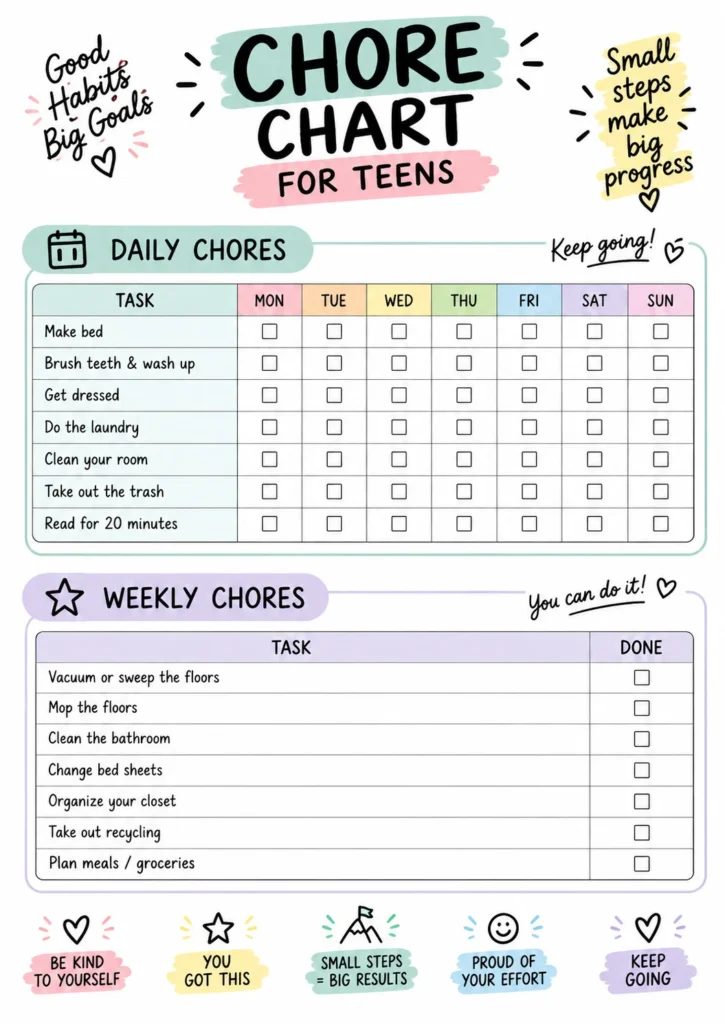
- Removing Parental Emotion: A visual schedule acts as a neutral third party. When expectations are clearly documented on a shared chart, the parent no longer needs to play the role of the nagging enforcer. The chart says what needs to be done, neutralizing emotional conflicts instantly.
Part 2: The Architecture of Habit Formation
2.1 Cue, Routine, and Reward for Adolescents
Behavioral psychology teaches us that habits are built on a three-part neurological loop: a cue, a routine, and a reward. In households without visual systems, the cue is usually inconsistent (“Mom yelling about the trash”), which leads to a resentful routine (“dragging feet while complaining”), resulting in zero positive reinforcement.
- Establishing Clear Cues: A visual tracker provides a consistent, unblinking cue that is always present. The teen looks at the board, sees their responsibility for the day, and initiates the routine on their own terms.
- Internal Satisfaction: For teenagers, the reward shifts from material bribes to the satisfaction of crossing an item off the list, earning their independence, and enjoying stress-free weekend downtime.
2.2 Consistency as the Ultimate Teacher
Habits are forged through repetition, not lectures. When a chore happens on a predictable schedule week after week, it stops being a point of negotiation and becomes part of the household rhythm. Resistance naturally fades when tasks are expected, planned for, and integrated into the weekly routine.
Part 3: Deploying Your Routine Solution
3.1 Transitioning From Conflict to Cooperation
Moving from daily power struggles to a harmonious routine requires a deliberate reset meeting.
- The Collaborative Reset: Sit down with your teenager when everyone is calm. Acknowledge that past chore enforcement has led to too much friction, and propose a new, objective system where everyone has clear, predictable expectations.
- Instant Implementation: Keep the rollout frictionless by utilizing clean, ready-to-print routine planners that establish professional, mature structures in minutes without complicated setup.
3.2 Sustaining Long-Term Compliance
Once your system is active, protect it by maintaining consistency. Avoid the trap of re-introducing nagging; if a task is missed, point calmly to the chart and let the agreed-upon family guidelines dictate the outcome. Over time, your teen will learn that cooperating with the routine is much faster and easier than fighting it.
Conclusion & Final Thoughts
Transforming your home from a daily battleground of eye-rolls and resistance into a cooperative, peaceful environment is one of the most rewarding shifts you can make during the teenage years. By replacing emotional nagging with objective, structured visual systems, you teach lifelong accountability while restoring harmony to your family.
Ready to replace daily conflict with effortless routine? Explore clean, professionally formatted ready-to-print routine planners to get started today.