
Potty Training Visual Schedule: The Secret to Stress-Free Restrooms
Ask any parent who has recently navigated the toilet training trenches about their greatest challenge, and they will rarely cite the physical logistics of washing clothes or cleaning floors. Instead, parents almost universally point to the emotional friction: the sudden stubbornness, the dramatic drop to the floor, the daily arguments, and the sheer stress of turning a simple bodily function into a high-stakes household battleground. When children enter the early toddler years, asserting independence becomes their full-time occupation, and if they feel managed or cornered, resistance is instantaneous.
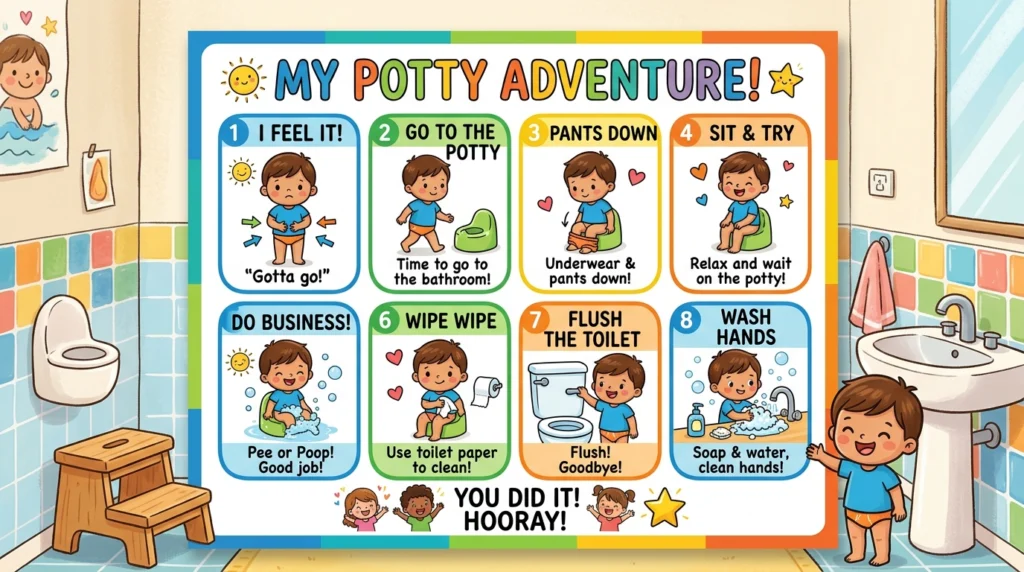
For many households, restroom trips become stressful because communication relies heavily on vague verbal demands or rushed commands. Telling a two- or three-year-old to “stop playing right now, walk down the hall, and use the potty” frequently triggers an automatic defensive reflex. The proven secret to turning high-stress restrooms into peaceful, cooperative environments lies in shifting away from spoken nagging and toward an objective, predictable framework. Utilizing a dedicated potty training visual schedule diffuses tension entirely, replacing parental pressure with a clear, empowering roadmap that children can follow on their own terms.
Part 1: Unmasking the Roots of Restroom Stress
1.1 Why Traditional Verbal Commands Trigger Defiance
To successfully eliminate household stress, we must understand how a toddler’s brain processes stress and authority. Between the ages of two and four, children experience a massive developmental surge in autonomy. They realize they are separate individuals from their parents, and they crave control over their environment.
- The Threat of Abruption: When an adult abruptly interrupts a child’s deep play state to demand a trip to the bathroom, the child experiences an abrupt loss of agency. Resisting the command feels like the only way to protect their autonomy.
- Cognitive Congestion: Young children have limited working memory capacity. Multi-step verbal instructions cause mental traffic jams, leading to confusion, overwhelm, and the inevitable toddler meltdown.
1.2 The Calm of Predictability
Uncertainty breeds anxiety, and anxiety is the primary engine behind bathroom resistance. If a child does not know what a bathroom trip entails, how long it will take, or why they have to stop playing, they will fight against it. A visual schedule removes the mystery. When the steps are laid out clearly from start to finish, the nervous system calms down, transforming a stressful unknown into a predictable, safe routine.
Part 2: The Architecture of a Stress-Free Bathroom Routine
2.1 Breaking Down the Sequence Into Manageable Micro-Steps
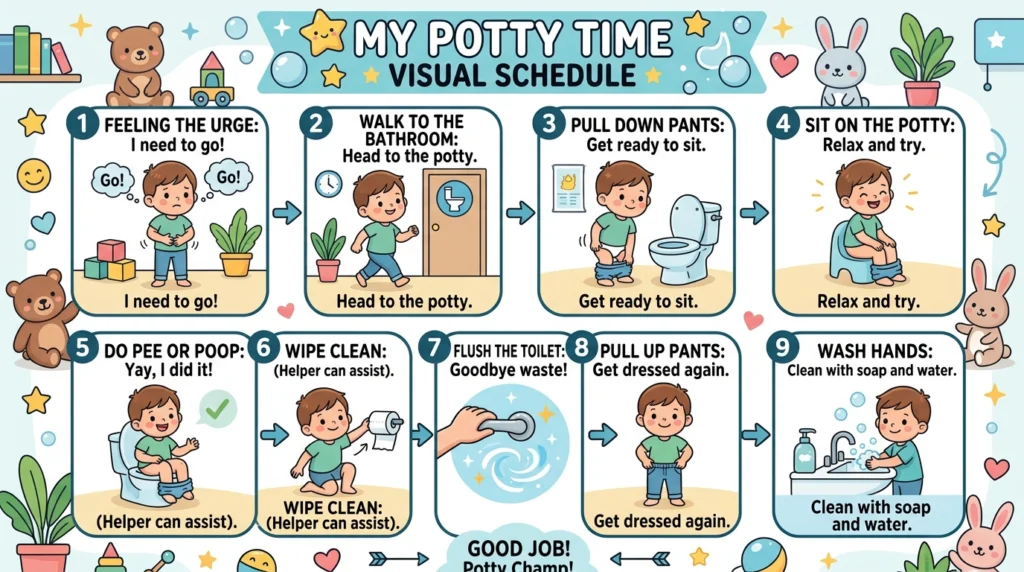
A well-designed visual schedule reduces stress by deconstructing an intimidating task into bite-sized, achievable components:
- The Transition: Acknowledging the cue or scheduled time to walk into the bathroom peacefully.
- Clothing Management: Lowering pants and undergarments independently or with minimal, supportive guidance.
- The Seating Stage: Settling comfortably onto the potty seat or reducer ring without rushing.
- The Hygiene Finish: Wiping, flushing, washing hands thoroughly with soap, and drying them.
2.2 Fostering Intrinsic Motivation Over External Bribes
While stickers and treats can offer short-term distractions, true stress-free harmony comes from intrinsic motivation. When a visual tool allows a toddler to look at a picture, complete a step, and check it off themselves, they experience genuine pride. They stop cooperating merely to appease an anxious parent and start cooperating because they feel capable and proud.
Part 3: Practical Implementation for Instant Relief
3.1 Creating a Low-Stress Environment
How and where you deploy your visual schedule dictates its success.
- Eye-Level Positioning: Mount your chart directly inside the bathroom at your toddler’s exact eye level, ensuring they can reference it independently without adult lifting or pointing.
- Collaborative Language: Change how you prompt your child. Stop issuing direct commands and instead invite partnership by pointing to the chart and asking, “What does our roadmap say we do next?”
3.2 Maintaining Calm Consistency
Even the best tools require steady consistency. When minor regressions or stubborn days occur, keep your emotional tone neutral and quiet. Point back to the visual schedule, offer a reassuring smile, and let the structured steps guide you through the moment without drama.
Part 4: Long-Term Transition to Autonomous Hygiene
4.1 Fading the Schedule Into Muscle Memory
Visual schedules are brilliant training wheels, but they are designed to be temporary scaffolding. As weeks pass and the bathroom routine becomes second nature, your child will naturally stop referencing the chart. The behavior will transition into automatic, lifelong habit.
4.2 Building Lasting Resilience
The confidence a child gains from mastering a stress-free restroom routine echoes far beyond the bathroom door. When toddlers realize they can follow a visual guide and succeed through their own efforts, that self-efficacy fuels their approach to every future developmental milestone.
Conclusion
Toilet training does not have to be an exhausting cycle of friction, tears, and constant household stress. By replacing verbal nagging with a clear, structured visual workflow, you create an environment of emotional safety, predictability, and genuine cooperation.
Embrace supportive structural frameworks today to turn high-stress bathrooms into spaces of calm confidence, ensuring a smooth, friction-free journey toward permanent independence.