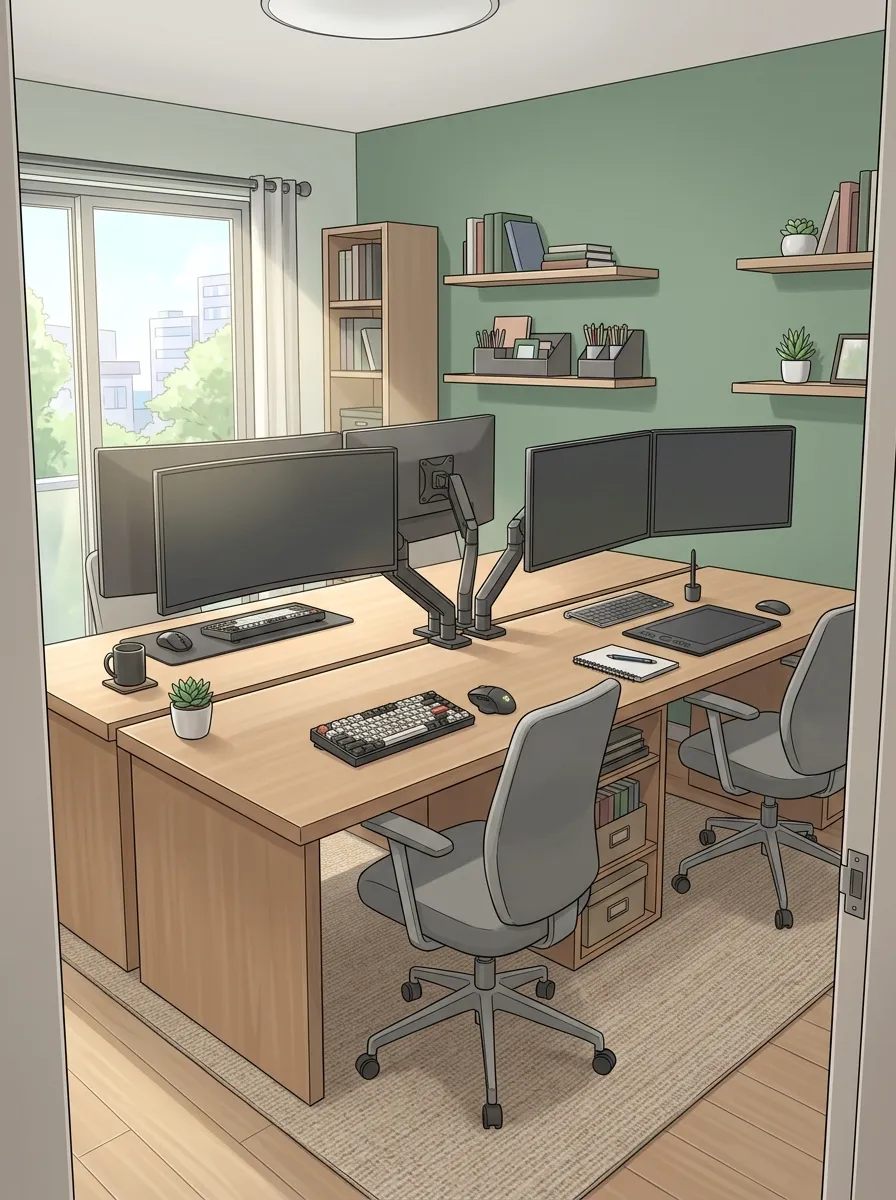
9 Home Office Ideas for Two Shared Spaces
Working from home with another person in the same space is one of those situations that sounds completely manageable until it isn’t. Day one: charming. Day four: one person is on a call while the other is trying to concentrate, the desk setup is generating a shadow on the wrong screen, the chair heights are perpetually wrong, and the WiFi router is somehow positioned to serve only one of the two workstations effectively. Romantic partnership, professional cohabitation, or roommate agreement — the shared home office has the potential to be a genuinely functional, beautiful dual workspace or a slow-motion productivity disaster. The difference is design.
Home office ideas for two are fundamentally different from single-person office design because they have to solve two problems simultaneously: creating individual zones that allow each person to focus, and creating a shared environment that doesn’t feel like a contested territory. The tension between “this is my space” and “this is our space” is real, and it plays out in desk positioning, storage allocation, lighting setups, and the deceptively consequential question of which direction each person faces during video calls.
Here’s what workplace designers and interior architects have known since the open-plan office era: proximity doesn’t have to mean distraction. The right spatial design, acoustic strategy, and visual division can make two people working in the same room feel as productively separate as if they were in two different buildings — while maintaining the human benefit of not actually being alone all day. That’s the dual home office brief, and it’s a solvable one.
Whether the shared office is a dedicated room, a converted guest bedroom, an alcove off the living area, or a bedroom corner divided with creative intent — these 9 home office ideas for two will maximize the space, minimize the friction, and create a workspace that serves both people without compromising either.
Let’s jump into the dual workspace ideas that make sharing an office something to appreciate rather than survive.
1. Back-to-Back Desk Layout With a Central Shelf Divider
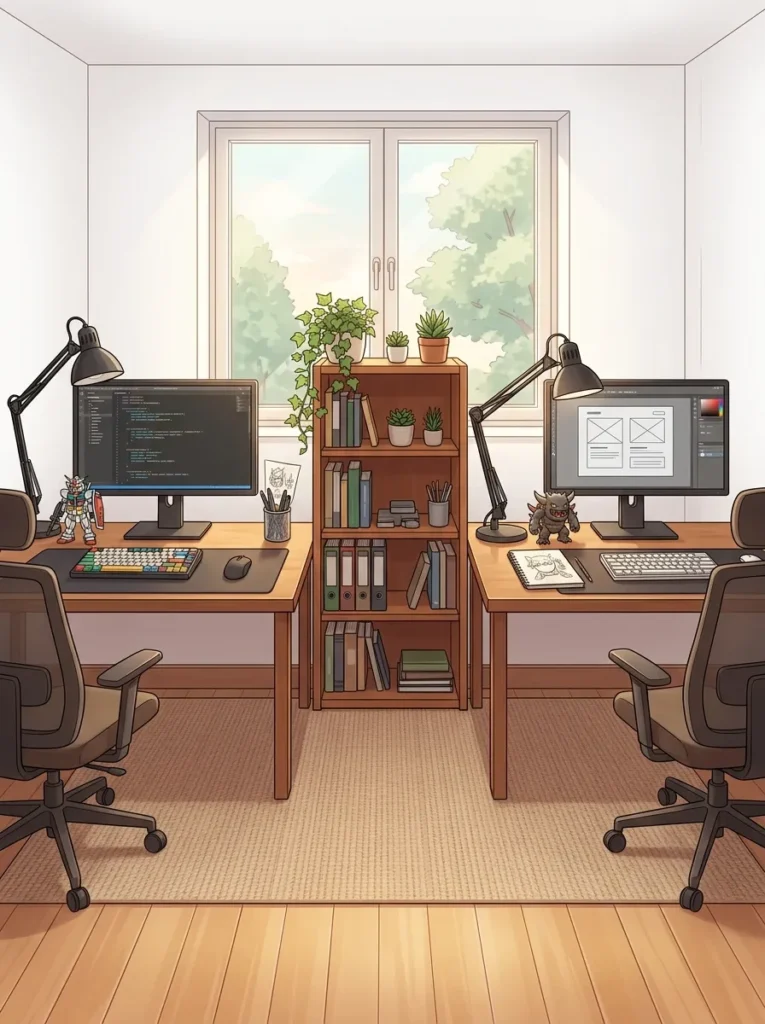
The back-to-back desk configuration is the most spatially efficient and psychologically effective layout for home office ideas for two — because it gives each person a clearly defined, forward-facing workspace while keeping the overall footprint compact. The central bookshelf divider is the design masterstroke: it physically separates the two zones, provides shared storage in the middle, and eliminates the slightly uncomfortable experience of staring directly at another person across a desk for eight hours a day.
- The shelf divider height matters: 36–48 inches provides visual separation while keeping the room feeling open
- Open shelves allow both people to access shared items (printer, reference books) from either side
- Each person’s desk faces outward — toward a wall, window, or their own section of the room — for maximum focus
- Keep the divider styled with shared, neutral objects: plants, books, a small speaker — items that belong to both workstations
This is the home office layout that makes two people sharing a room feel like they each have their own office. That’s the goal — and this configuration delivers it consistently.
2. Side-by-Side Window-Facing Desks With Individual Zones
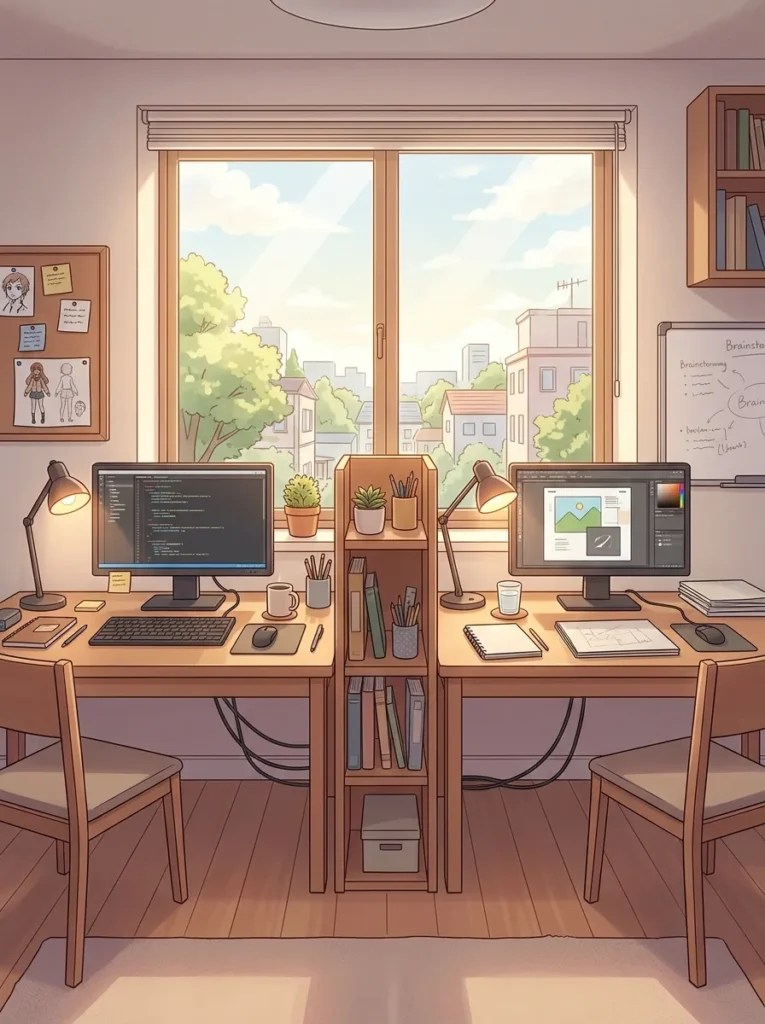
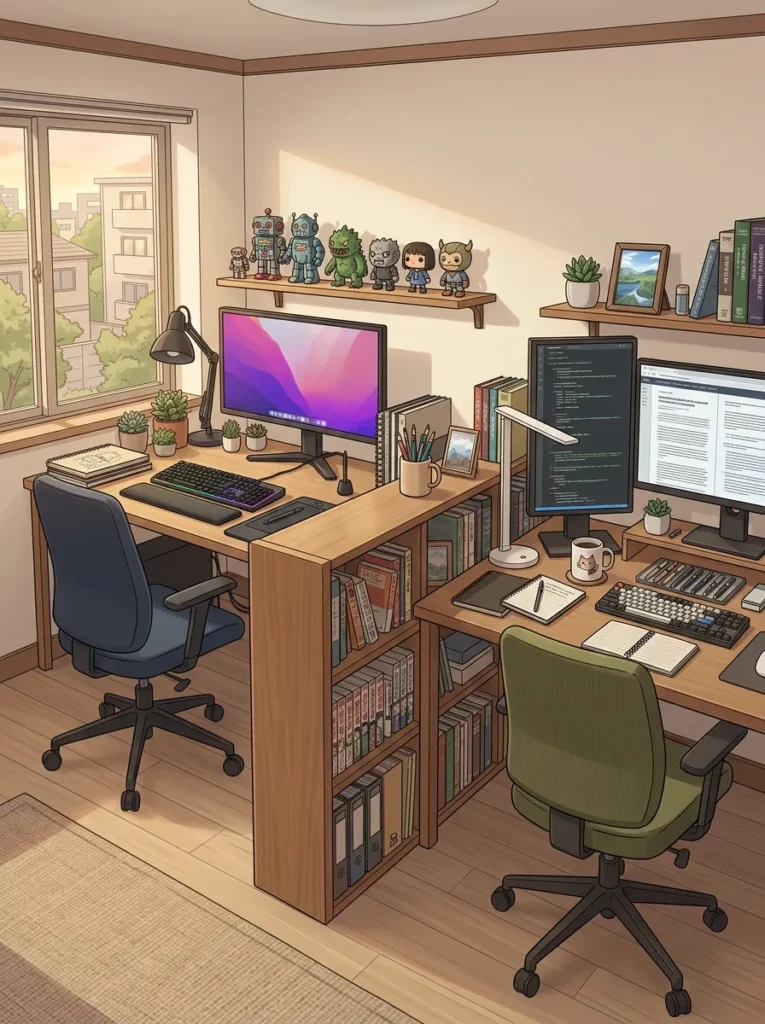
When the room has a window worth facing — natural light, a garden view, the kind of outlook that makes a workday feel less like a workday — positioning both desks to face it side-by-side is the layout that maximizes the shared benefit of that asset. The key is creating enough individual zone definition within the shared desk run to maintain the psychological sense of a personal workspace.
- A slim vertical shelf unit between the two desks creates a visual divider without blocking the window
- Keep the desks at a consistent height (same desk unit or custom-cut surfaces from a single board) for a cohesive, built-in aesthetic
- Individual task lamps on each side ensure neither person is dependent on the other’s lighting
- Position monitors facing the window wall — not toward each other — to eliminate screen-glare cross-interference and maintain focus
Shared view, separate focus. That’s the window-facing dual desk setup delivering its best work.
3. Acoustic Panels and Sound Management Solutions
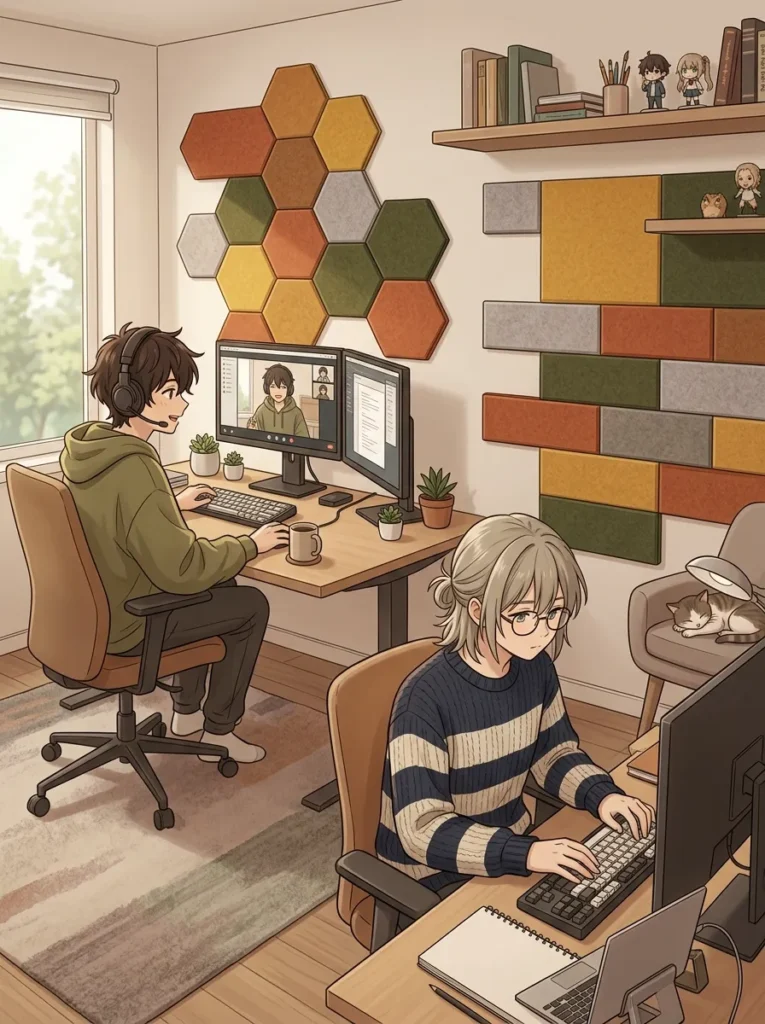
Nothing disrupts a shared home office faster than one person’s video call invading the other person’s concentration. Among home office ideas for two, acoustic management is the most practically important and most consistently overlooked element — because sound is the primary source of friction in shared workspaces, and it requires intentional design rather than hoping the other person keeps it down.
- Acoustic panels on the wall behind each desk absorb sound before it travels across the room
- Decorative felt acoustic panels (geometric shapes, fabric-wrapped frames) are visually attractive enough to function as wall decor
- Adding a bookshelf full of books between the two zones provides significant passive sound absorption — books are excellent acoustic buffers
- Over-ear noise-canceling headphones for each person are the non-negotiable personal equipment solution alongside physical acoustic treatment
Bold claim: solving the sound problem in a shared home office improves both people’s productivity more than any furniture upgrade. It’s the intervention that makes everything else work.
4. Height-Adjustable Standing Desks for Both Workstations
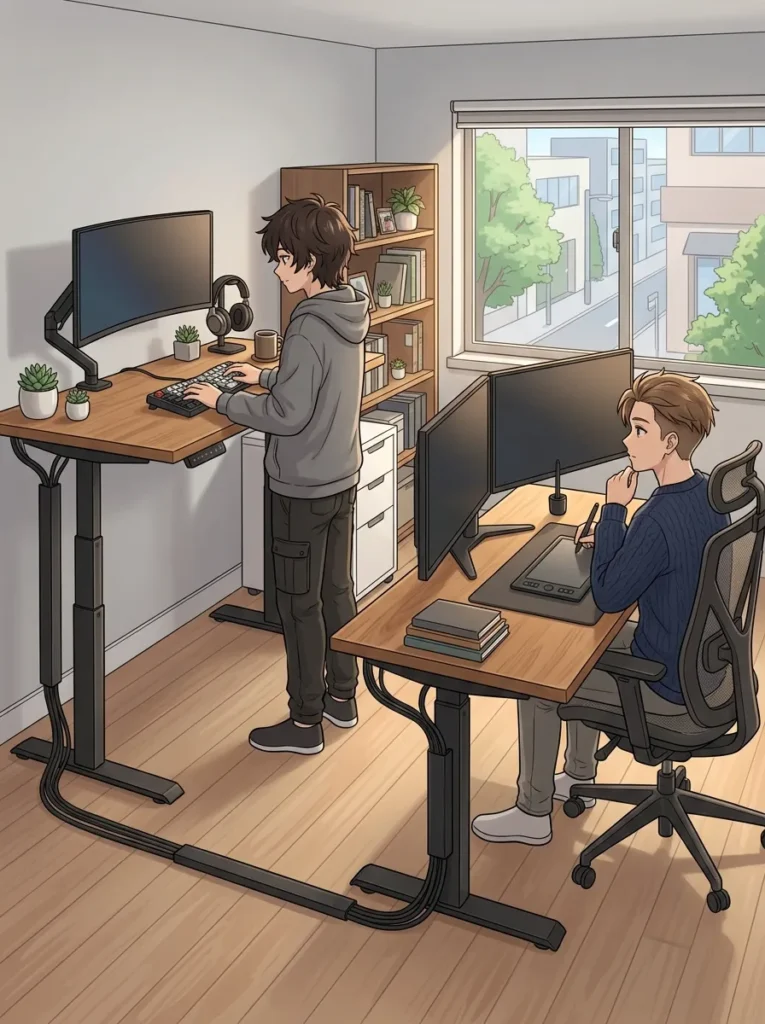
Two people sharing an office almost never need the same desk height — and a fixed desk that suits one person perfectly will cause the other chronic discomfort over months of daily use. Height-adjustable standing desks for both workstations solve this problem definitively: each person sets their own ergonomic position, each person can alternate between sitting and standing independently, and neither person’s physical comfort is a compromise of the other’s.
- Each person should have their own independent desk with their own height memory settings — sharing a single adjustable unit creates constant adjustment friction
- Matching desk surfaces (same material and color) create visual cohesion in the shared space even with different heights
- Anti-fatigue mats at each standing position are the ergonomic companion that makes standing desk use actually sustainable
- Cable management is doubly important with two desks — invest in under-desk cable trays and velcro ties to prevent the room from looking like a server rack
The ergonomic dual standing desk setup is the home office ideas for two upgrade that both people will immediately notice in their physical wellbeing. That’s real return on investment.
Balancing dual desks while keeping a cohesive design aesthetic requires clear boundaries, a shared layout that is beautifully complemented by a stylish study wall decor ideas aesthetic backdrop.
5. A Shared Command Center Wall With Individual Sections
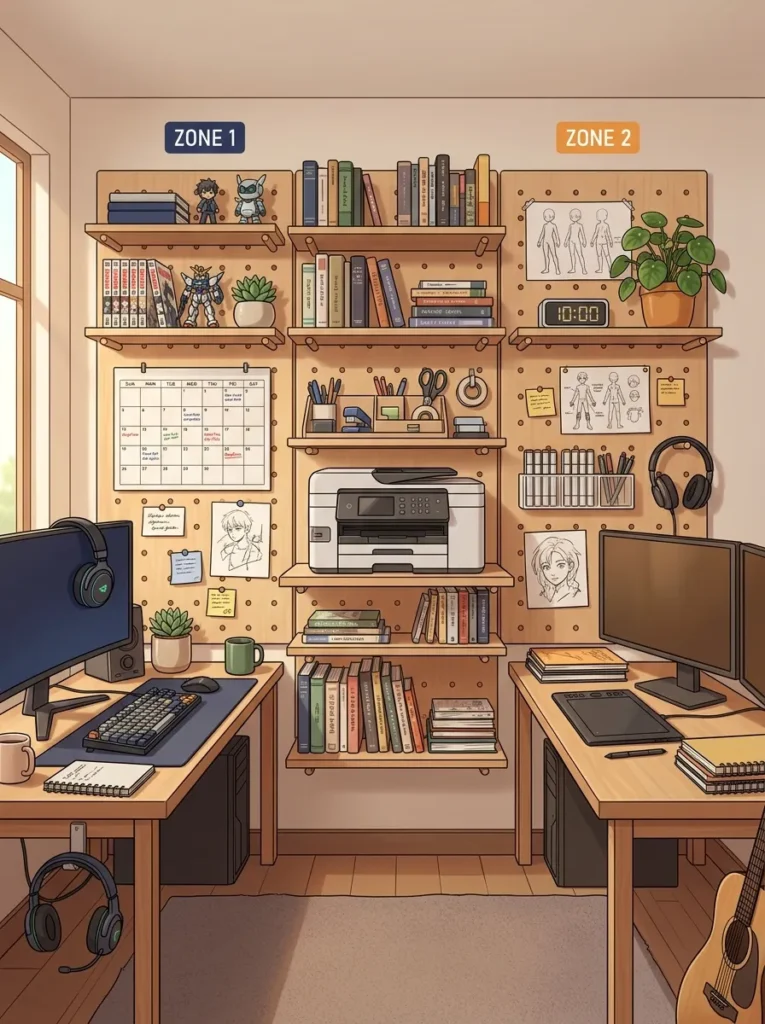
A shared command center wall — a full wall of pegboard, floating shelves, and mounted organizers — is the home office ideas for two storage solution that keeps both people organized without requiring a room twice the size. The key is dividing the wall into three visible sections: person A’s zone on the left, shared resources in the center, and person B’s zone on the right. Visual clarity prevents the gradual territorial creep that inevitably happens when shared storage has no defined ownership.
- Label or visually differentiate each person’s section with a different accent color, material, or organizational system
- The shared center section holds items used by both: the printer, shared reference books, the router, shared stationery
- Pegboard accommodates changing needs — hooks and organizers reposition as work requirements evolve
- A small whiteboard or chalkboard in each person’s section provides a scratch space that doesn’t require shared resources
The command center wall is the shared office’s organizational backbone. Get it right and everything else in the room falls into place.
This post contains affiliate links. If you buy something through them, I may earn a small commission at no extra cost to you.
6. Dual Monitor Arms to Free Up Desk Surface
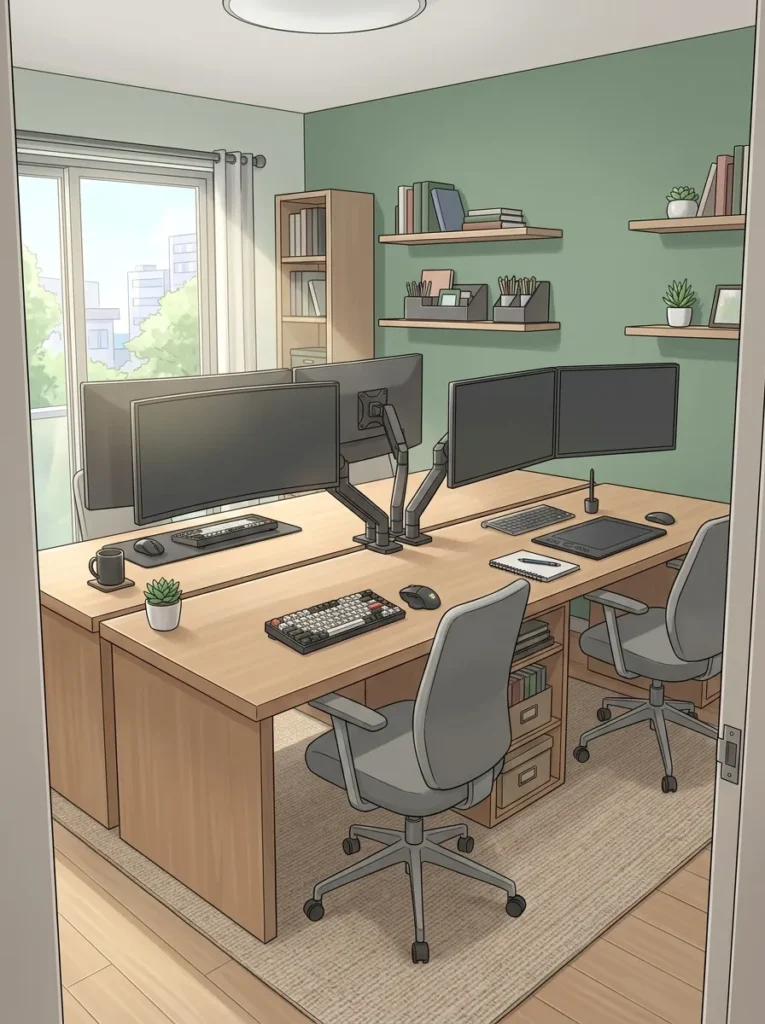
In a shared home office where desk space is finite and shared, monitor arms are among the highest-impact home office ideas for two — because they reclaim the entire footprint of the monitor stand. A monitor on a stand occupies a fixed portion of the desk surface and restricts placement options. A monitor on an arm floats at exactly the right ergonomic height and angle, freeing the desk surface completely and allowing the workstation to be repositioned when needed without moving the screen.
- Dual monitor arms mounted to the desk edge position screens at the precise ergonomic height (eye level at arm’s length) regardless of desk height
- The freed desk surface below the mounted monitor is genuinely significant — typically 8–12 inches of depth returned to working space
- Arms with cable management channels eliminate the monitor cable mess that plagues desk surfaces
- Full-motion arms allow screens to be swiveled toward a collaborator during shared review sessions — a practical benefit in a two-person office
Two monitor arms, two workstations, two dramatically cleaner desks. The arithmetic is simple and the impact is immediate.
7. Zoned Lighting — Individual Task Lights Plus Shared Ambient
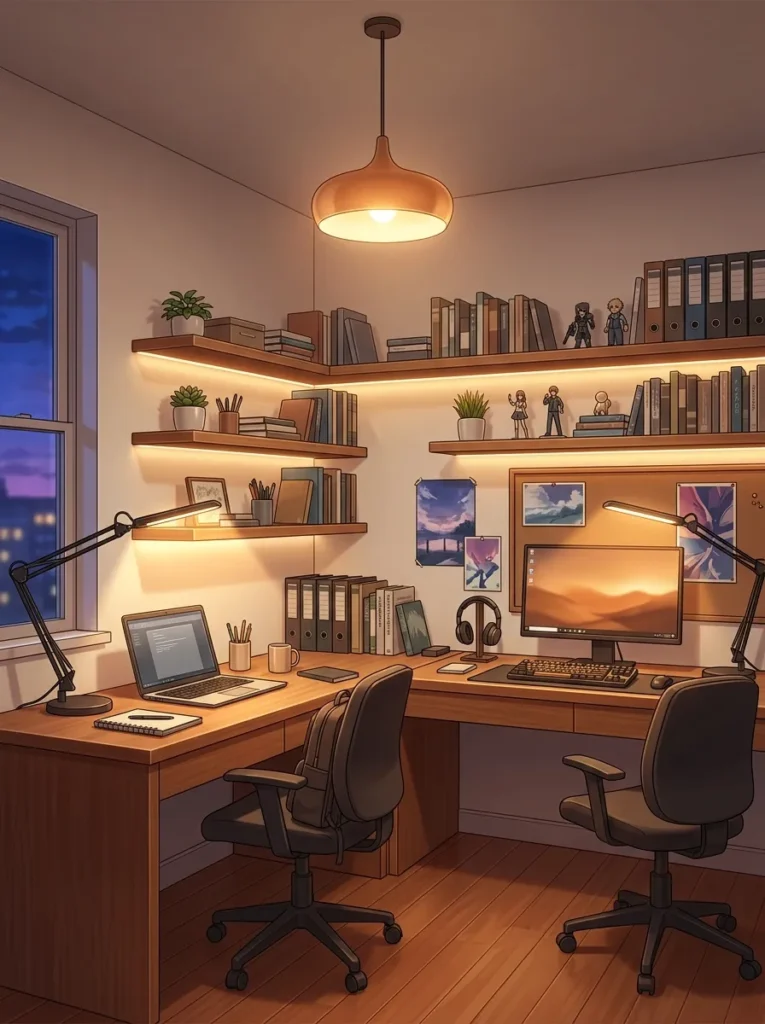
Lighting in a home office ideas for two context has to solve two distinct problems: providing each person with adequate, shadow-free task lighting for their specific workstation, and providing the shared room with ambient lighting that doesn’t create glare on either person’s screen. These are two different lighting jobs that require two different strategies — and combining them correctly makes the shared office visually comfortable for both people regardless of the hour.
- Each desk needs its own task lamp positioned to light the working surface without creating screen glare — left-side placement for right-handed workers, right-side for left-handed
- Warm white bulbs (2700K–3000K) reduce eye strain over long work sessions compared to cool or daylight-spectrum bulbs
- A shared overhead pendant or ceiling fixture provides room-level ambient light — on a dimmer for flexible control
- LED strip lighting along shelving or behind monitors as bias lighting reduces contrast between the bright screen and darker room — a significant eye strain reducer over a full workday
Neither person’s lighting should cast shadows on the other’s workspace. That’s the lighting brief — and zoned individual task lights solve it completely.
8. Strategic Privacy Screens or Curtain Dividers
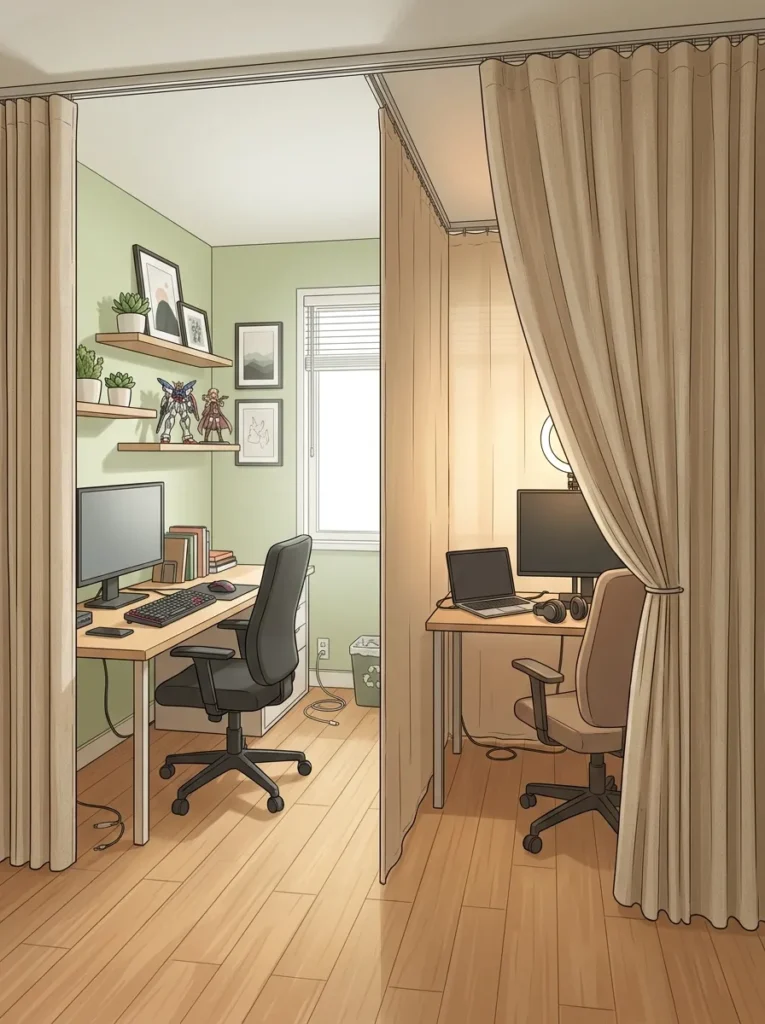
There are moments in every shared home office day when one person needs genuine visual privacy: the sensitive client call, the confidential review, the video meeting that the background-blur filter can’t quite rescue. A ceiling-mounted curtain track with a full-height fabric curtain panel provides instantly deployable privacy that’s completely out of the way when not needed — and more elegant than a folding screen dragged across the room.
- Ceiling-mounted curtain tracks require minimal installation and work on any ceiling type with standard hooks
- Choose a fabric that absorbs some sound (velvet, heavy linen, layered cotton) for acoustic benefit alongside the visual privacy
- When open, the curtain gathers neatly against the wall or behind a piece of furniture — zero footprint in the day-to-day setup
- This solution works brilliantly in rooms that also need occasional conversion to a single-person space or guest bedroom
The curtain divider is the shared office solution that respects both people’s need for independence without requiring the room to be redesigned every time someone has a call.
9. A Shared Inspiration and Mood Board Wall
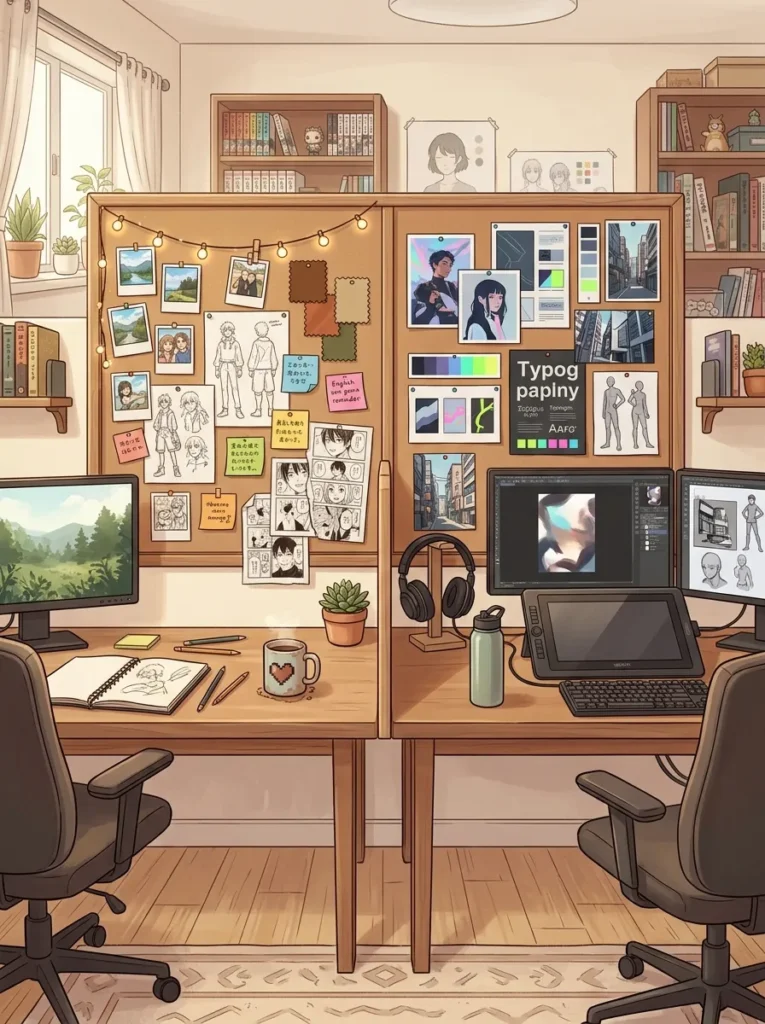
Every great shared office needs at least one element that belongs to both people equally — a shared creative resource rather than a divided territory. A large pinboard, gallery rail, or mood board wall mounted between or above the two workstations provides just that: a visual inspiration zone that reflects both people’s current projects and creates the kind of ambient creative energy that individual workstations rarely generate alone.
- Cork board or fabric pin boards in a large format (at least 36×48 inches) accommodate both people’s materials comfortably
- A gallery rail system (a horizontal rail with clips) allows materials to be swapped without holes in the board — ideal for frequent project changes
- Divide the board visually but not rigidly — a clear center point with each person’s materials on their respective side, but allowing the energy to bleed into the middle
- Include shared inspiration alongside individual project materials: a map of somewhere both want to go, a quote that matters to both, a piece of art that anchors the room’s creative ambition
The shared mood board makes a home office feel like a studio. And that shift — from functional room to creative environment — is the intangible upgrade that makes both people want to work in it.
A shared home office is one of the most solvable design challenges in any home — and every idea on this list proves that two people working in the same space can actually be better than either working alone. Pick the layout that fits the room, commit to the acoustic and ergonomic fundamentals, and build the shared workspace that makes the workday something both people genuinely look forward to.