10 Stylish Living Room Hanging Plant Ideas to Elevate Your Decor
This post contains affiliate links. If you buy something through them, I may earn a small commission at no extra cost to you.
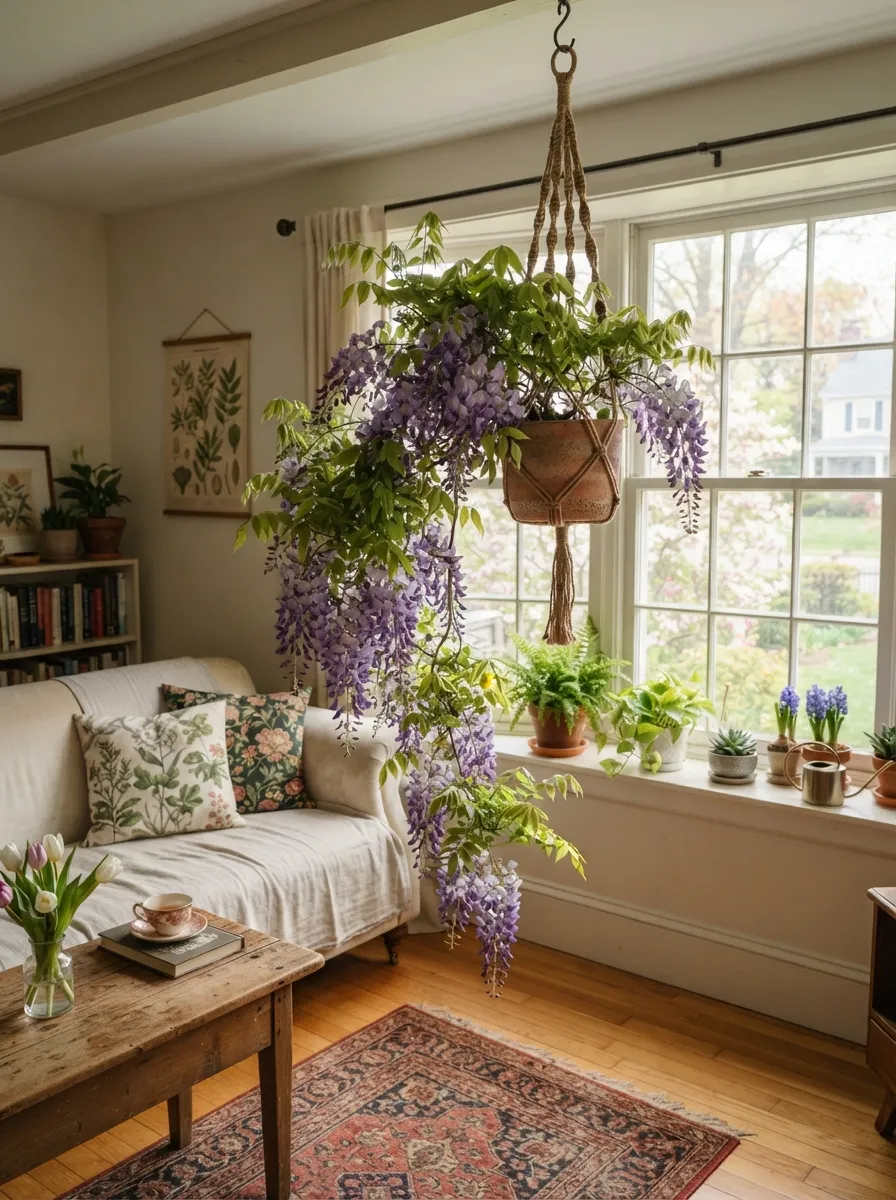
Every surface in the living room is already spoken for — the coffee table, the console, the one windowsill that gets decent light. Meanwhile the ceiling and upper walls sit there doing absolutely nothing.
Hanging plants fix that imbalance entirely, adding greenery exactly where floor and tabletop space run out. Here are 10 living room hanging plant ideas built to draw the eye upward without claiming a single inch of usable surface.
1. Suspend a Trailing Plant in a Macramé Hanger by the Window
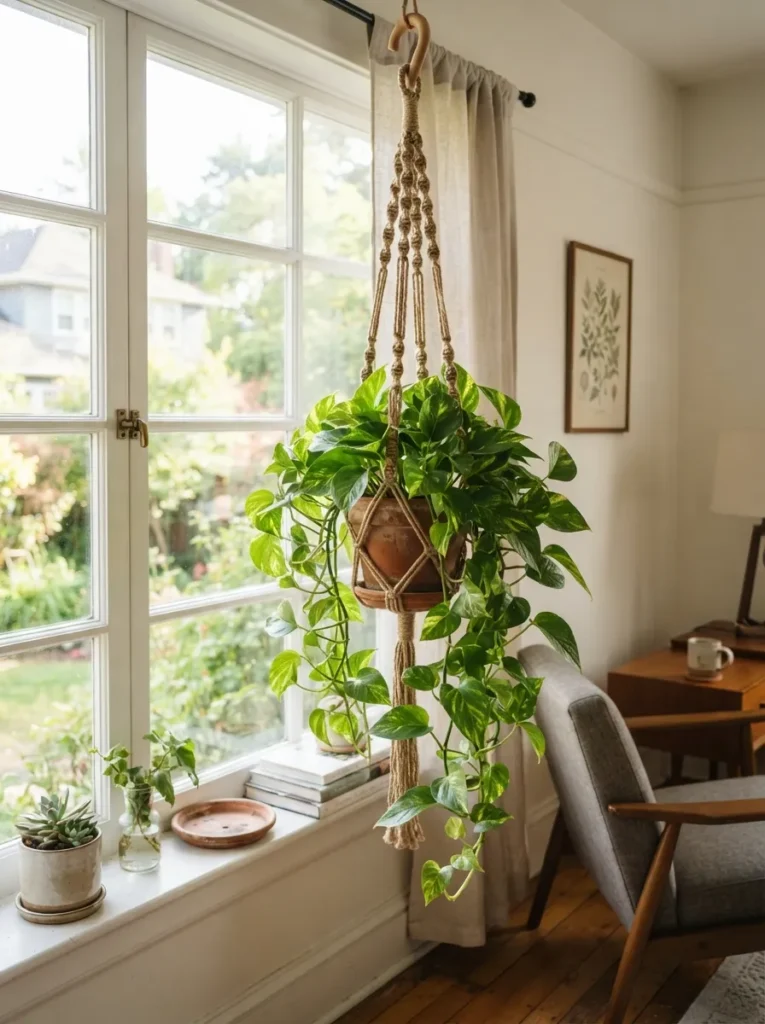
A macramé hanger does something a plain pot never can — it adds texture at eye level, right where the room’s negative space usually sits empty.
Pothos, string of pearls, or a trailing philodendron all suit this treatment well, since their cascading growth habit was practically designed for a hanging display.
Placement logic: hang it a few inches to the side of the window frame rather than dead-center, so the vines do not eventually block the view as they fill out and lengthen.
Material note: natural jute or cotton macramé softens a room, while a more structured leather or metal hanger reads sleeker and more modern — choose the fiber to match the room’s existing textures, not just the plant.
2. Mount a Ceiling Hook Directly Above a Reading Chair
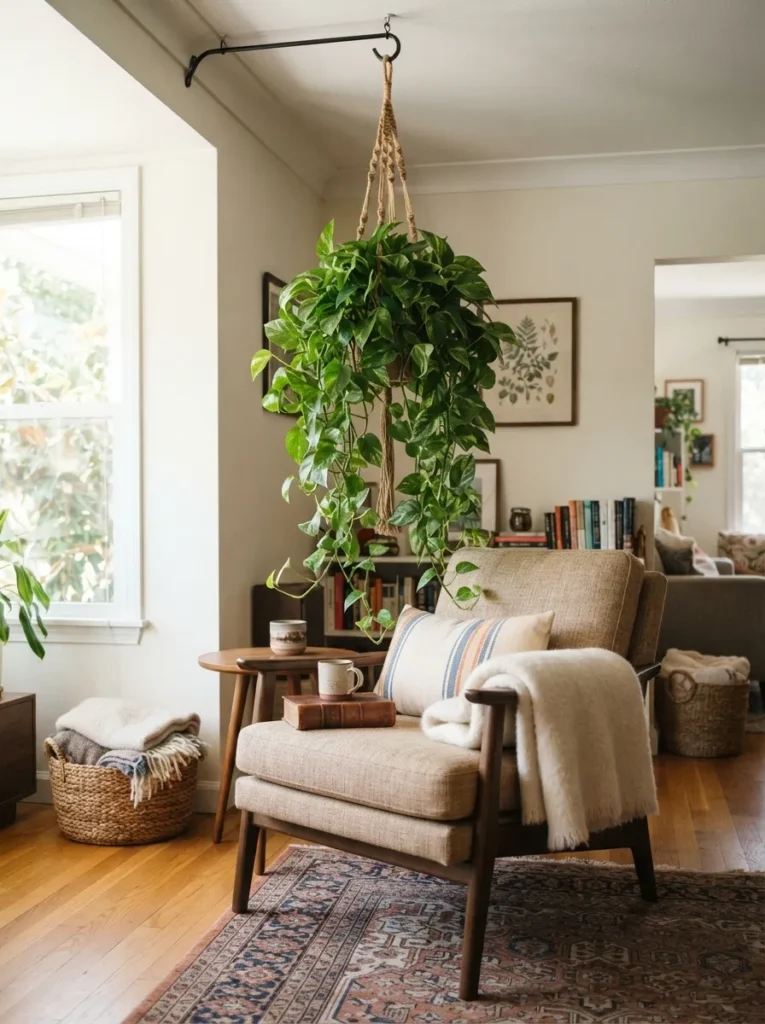
A reading chair with nothing overhead can feel a little exposed, like it is missing a canopy.
A single hanging plant positioned just above and slightly behind the chair adds that missing layer, creating a cozy, enclosed feeling without a single piece of furniture added to the floor.
Structural requirement: always anchor ceiling hooks into a joist, not just drywall — a fully watered hanging planter is heavier than it looks, and drywall anchors alone will eventually fail.
Lighting tip: position the hook near, but not directly under, a light fixture. Direct proximity to a hot bulb can dry out trailing foliage faster than expected.
3. Layer Multiple Trailing Plants at Staggered Heights
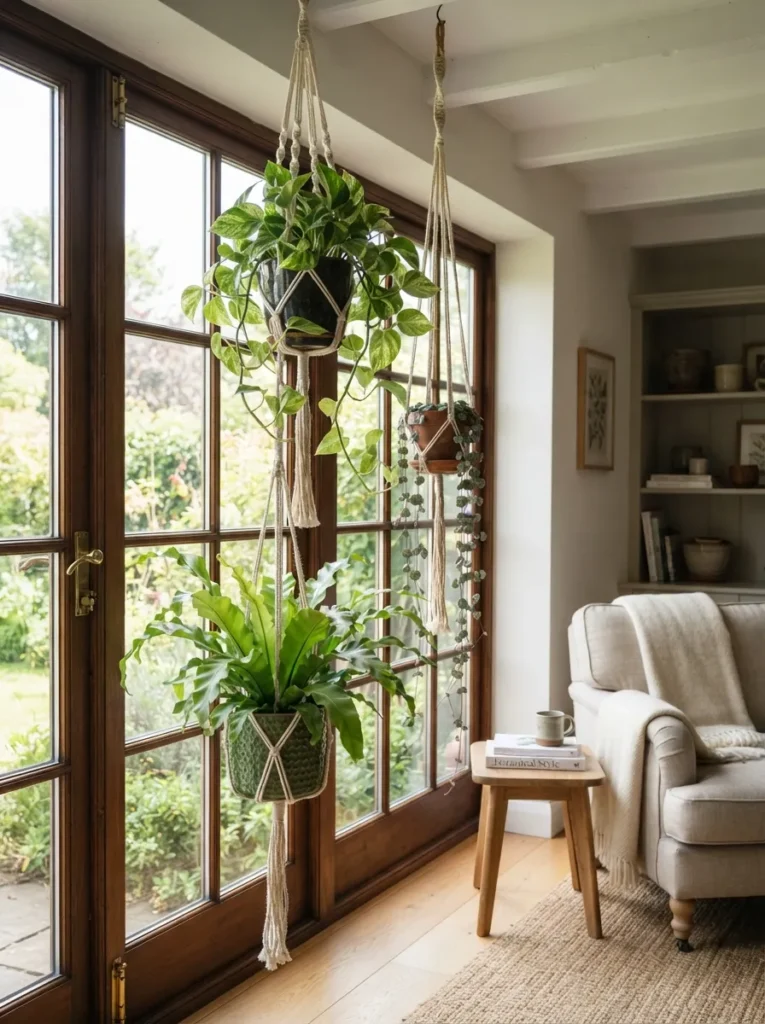
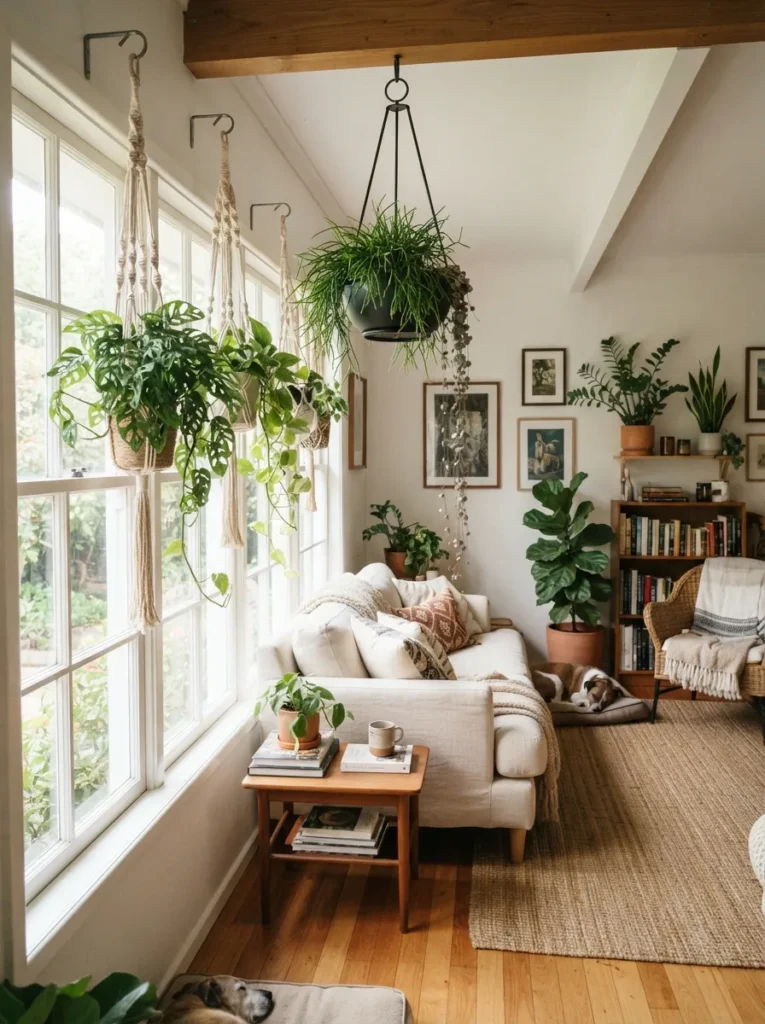
A single hanging plant makes a nice accent. Three, staggered at different heights, make an actual composition.
Varying the hanger length by six to twelve inches between each plant creates a layered, almost curtain-like effect that reads as considerably more intentional than plants hung in a flat, even row.
Why this works near windows: staggered heights let light reach all three plants at slightly different angles throughout the day, rather than the lowest plant shading out everything hung above it.
Balance rule: keep plant size proportional to hanger position — the largest, most established plant generally reads best hung lowest, with progressively smaller varieties higher up.
4. Use a Curtain Rod to Display a Row of Hanging Planters
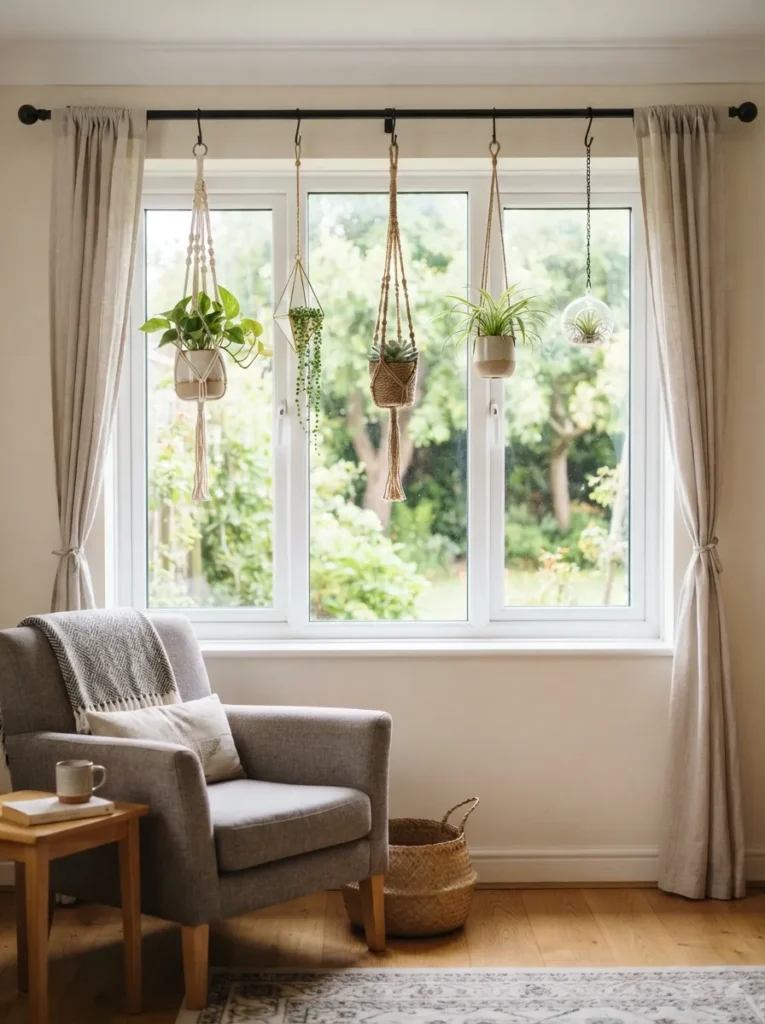
Not every hanging display needs a dedicated ceiling hook. An existing curtain rod, especially one extending a bit beyond the window frame, can double as a display rail.
Small planters clipped or looped along the rod create a full row of greenery without a single new hardware installation, provided the rod itself is rated for extra weight.
Weight check: confirm the rod’s load rating before adding more than one or two small planters — most curtain rods are engineered for fabric weight, not multiple ceramic pots.
Styling detail: this works best with lightweight plastic or resin planters rather than heavy ceramic, both for the rod’s sake and for easier repositioning down the line.
5. Cluster Hanging Baskets in an Empty Reading Corner
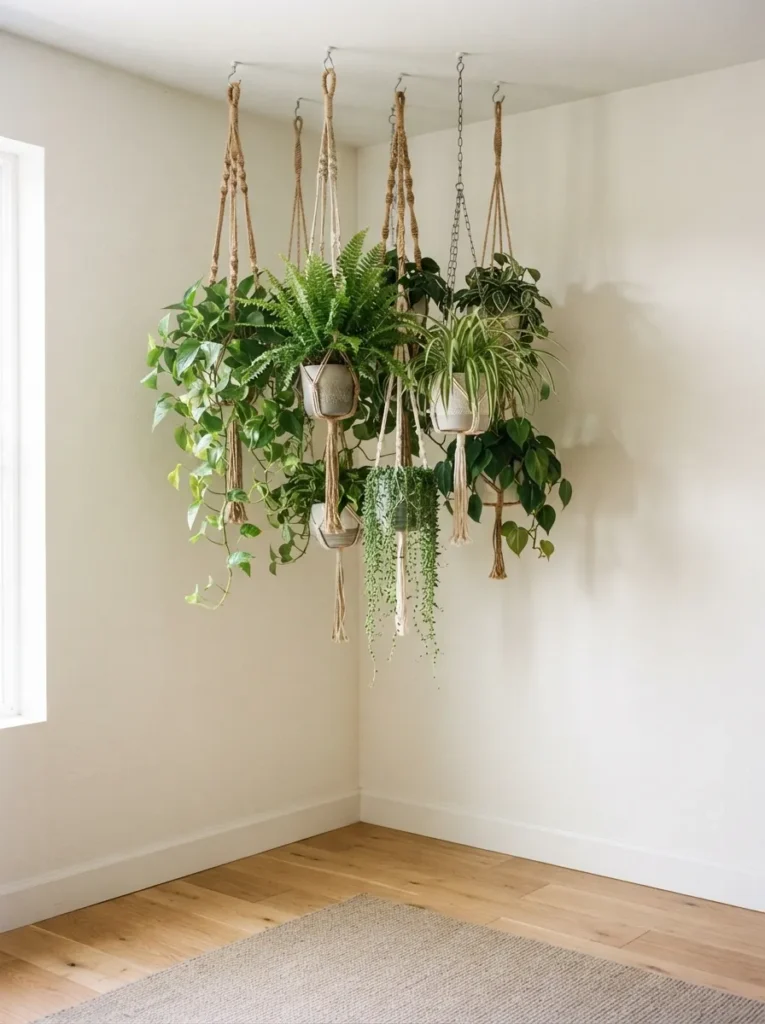
An empty corner without furniture potential does not have to stay empty. It just needs a reason to exist.
Clustering two or three hanging baskets together in that dead zone, rather than spacing them evenly around the room, creates a genuine greenery moment instead of a few scattered, disconnected accents.
Spatial advice: group hangers at slightly different lengths within the same general height range — think a twelve-inch spread rather than perfectly matched levels — to avoid a rigid, assembly-line look.
Why this solves a real problem: corners without adjacent walls for furniture are notoriously hard to style. Hanging plants solve that by using vertical space a chair or table never could occupy comfortably.
6. Add a Tiered Hanging Basket System for Maximum Impact
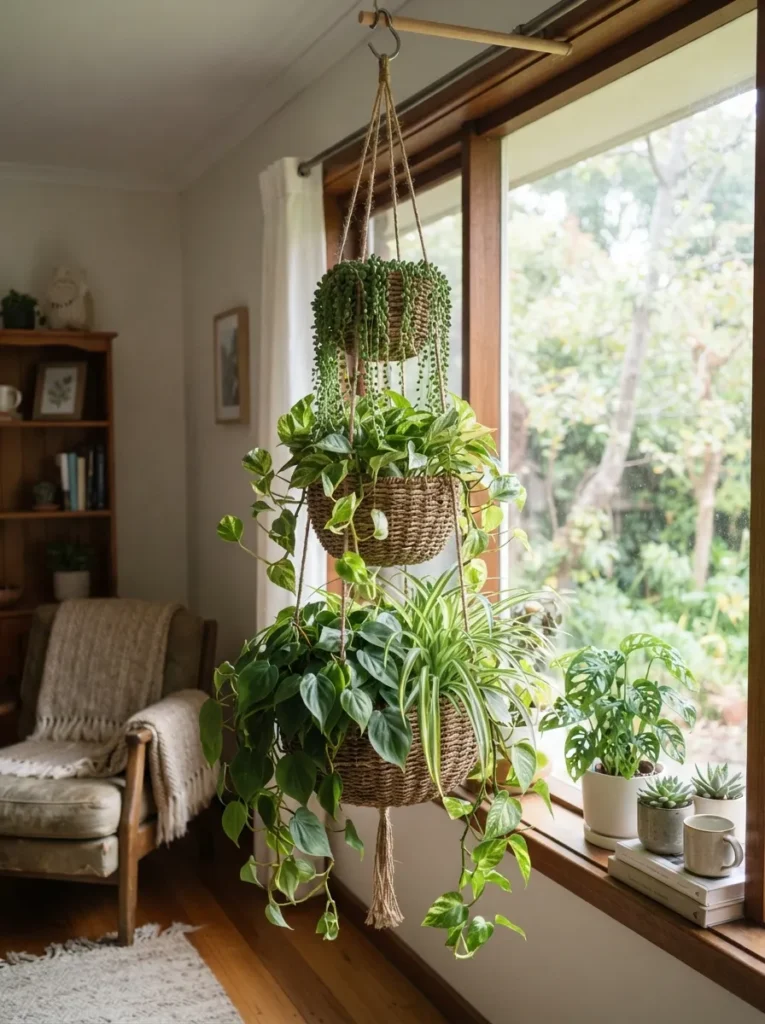
For anyone who wants more greenery than a single hanger can deliver, a tiered hanging system multiplies the display without multiplying the ceiling hooks.
These systems typically suspend three or four planters from one central point, cascading downward like a greenery chandelier rather than requiring separate anchors scattered across the ceiling.
Structural consideration: the combined weight of multiple watered pots adds up fast — confirm the central mounting point can handle the full loaded weight, not just the weight of the empty system.
Best use case: this works particularly well in rooms with taller ceilings, where a single-point tiered display has enough vertical room to cascade without crowding the furniture below it.
7. Choose a Wall-Mounted Bracket for a Trailing Plant
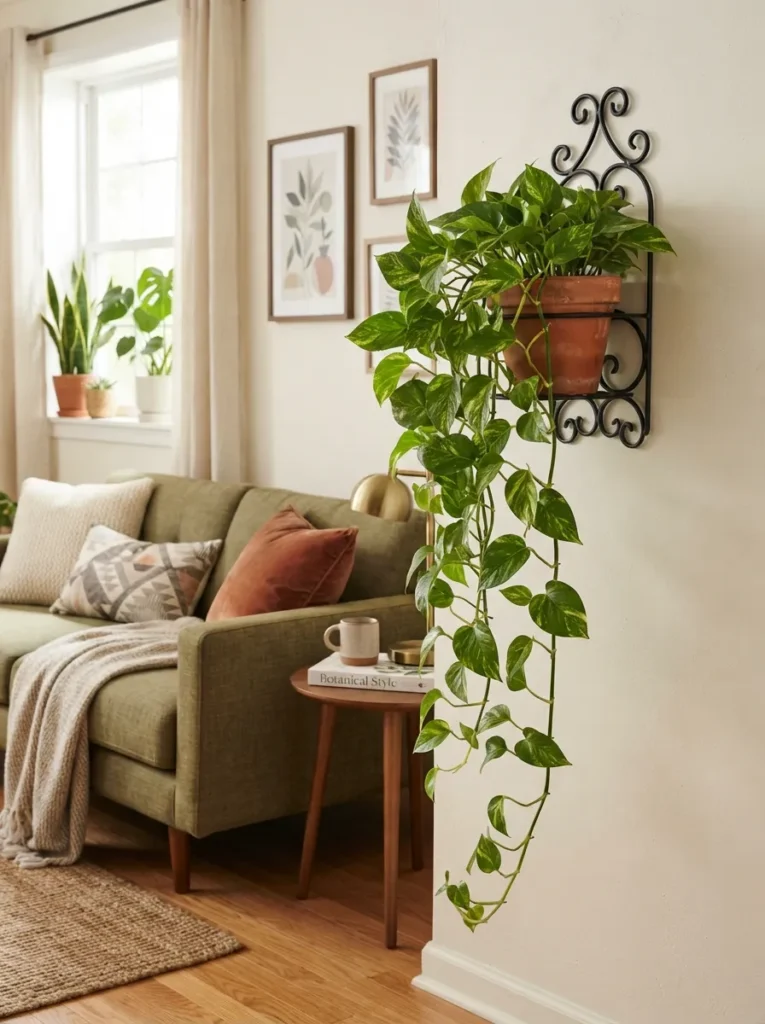
A wall bracket splits the difference between a hanging planter and a floating shelf — it holds the pot directly against the wall, letting vines trail downward from a fixed point.
This is a smart option for rooms without an easy ceiling access point, since brackets mount directly into wall studs instead.
holds a trailing plant directly against the wall when ceiling mounting is not an option.
🛒 Check Price on AmazonPlacement logic: mount the bracket at a height where trailing vines can cascade a couple of feet without brushing furniture or flooring, giving the plant room to actually show off its natural growth habit.
8. Use Adjustable Pulley Hooks for Easy Watering
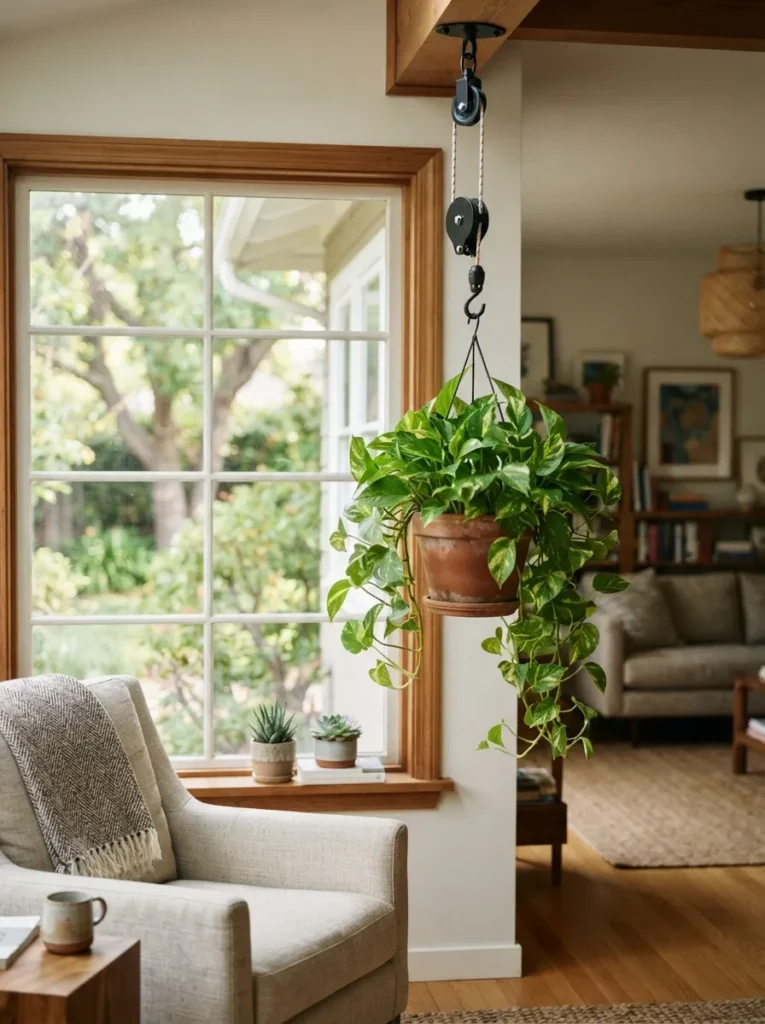
Watering a hanging plant mounted near a high ceiling is a genuine hassle — most people end up balancing on a chair with a watering can, hoping for the best.
An adjustable pulley hook solves that entirely, letting the whole planter lower down to an easy, accessible height for watering, then raise back up once finished.
lowers a hanging planter to a comfortable height for watering, then raises it back into place.
🛒 Check Price on AmazonPractical upside: this small hardware upgrade also makes seasonal repositioning easier, since the plant can be lowered and moved without needing a ladder every single time.
9. Pair Hanging Plants With a Sheer Curtain for Diffused Light
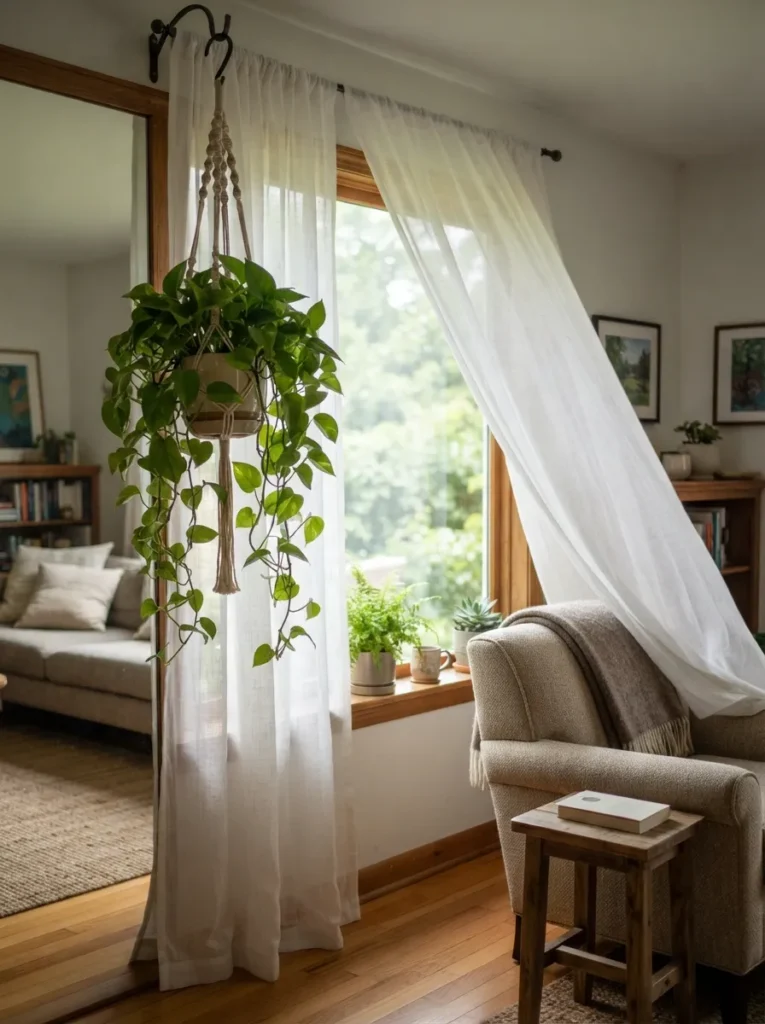
Hanging plants positioned close to unobstructed glass often get more direct, intense light than expected, since heat and sun exposure both increase near a bare window.
A sheer curtain layered behind the hanging display diffuses that intensity into something gentler, protecting more delicate trailing varieties from scorched, crispy leaf edges.
diffuses harsh direct sun for hanging plants positioned close to a bright window.
🛒 Check Price on AmazonMaterial note: choose a genuinely sheer, lightweight fabric rather than a heavier semi-opaque curtain — the goal is softening light, not blocking it entirely, which would starve the plant of the brightness it still needs.
10. Rotate Hanging Plants Seasonally for a Room That Evolves
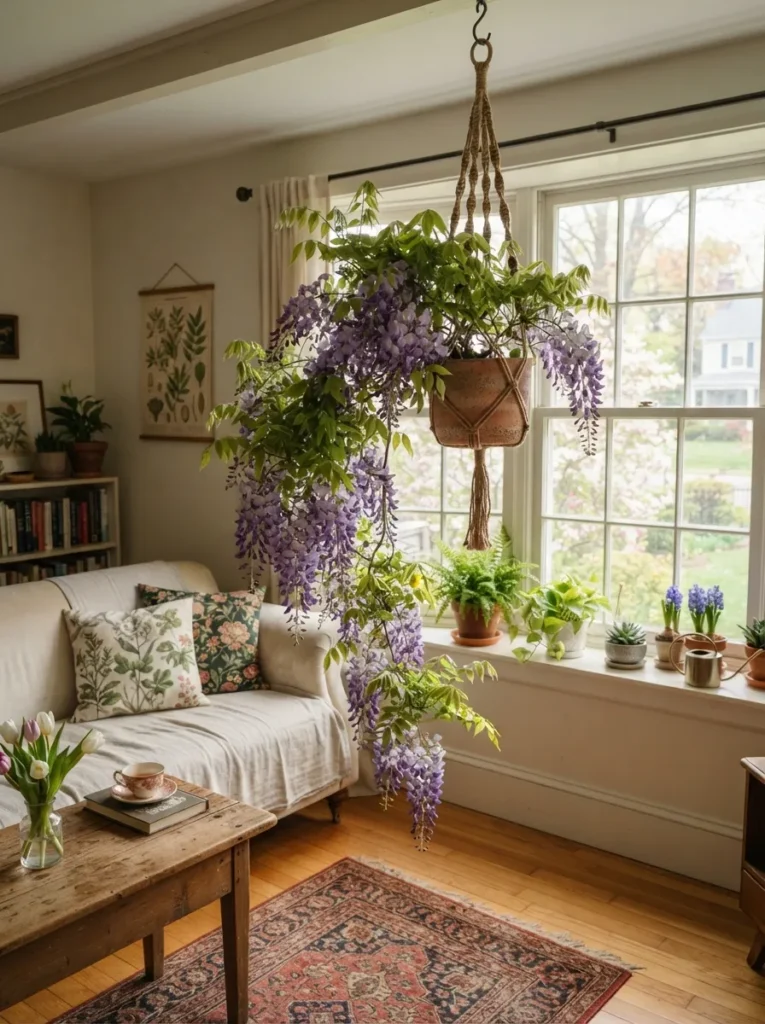
A hanging display styled once and left untouched for years can start to feel a little static, even with healthy, well-placed plants.
Swapping in a seasonal flowering trailing variety, or simply rotating which plant occupies the most prominent hanger, keeps the display feeling current without a full redesign every time.
Simple system: keep one or two permanent, structural trailing plants as the anchor of the display, and treat any seasonal swaps as smaller, temporary accents layered in in one additional hanger.
A living room finally feels finished once the ceiling gets invited into the design. Pick one of these living room hanging plant ideas, get the greenery off the floor, and let the whole space grow upward instead of just outward.